Individuals with Disabilities Education Act: Overview

The Individuals with Disabilities Education Act (IDEA) ensures states and territories provide early intervention, special education, and related services to more than 7.5 million eligible children and youth with disabilities across the country,1 including infants, toddlers, and preschoolers. IDEA’s early childhood programs play a critical role in identifying developmental delays, providing supports and services, and helping young children build the skills they need to succeed in school and in life.
Neural connections — the foundation for learning, behavior, and health — form most quickly and are most responsive to intervention in the first three years of life. As the brain matures, these connections become less adaptable.2 Access to inclusive early intervention services during this critical window helps young children build a strong foundation, develop important skills, and supports better long-term outcomes for children and families.
BACKGROUND
Since 1975, the federal government has supported educational opportunities for children with disabilities through a permanent, broad-scale federal assistance program. Originally enacted as the Education for All Handicapped Children Act and reauthorized as IDEA in 1990, the law provides federal funding for the education of children with disabilities and, as a condition of receiving those funds, requires states to provide a free appropriate public education (FAPE) to eligible children with disabilities at no cost to their families. According to the Centers for Disease Control and Prevention (CDC), nearly 9% of children in the United States have been diagnosed with a developmental disability, which includes autism spectrum disorder, intellectual disabilities, and any other developmental delays.3
For a majority of the program’s history, IDEA has been housed under the U.S. Department of Education (ED). However, in June 2026, the Trump administration announced that ED would partner with the U.S. Department of Health and Human Services (HHS) to assist with the administration of the Office of Special Education and Rehabilitative Services (OSERS), which oversees IDEA programs.4 ED stated that IDEA and its statutory functions would remain unchanged, federal funding would continue to flow to states, and OSERS would continue to enforce the law to ensure states and schools are in compliance.
EARLY INTERVENTION AND PRESCHOOL SPECIAL EDUCATION PROGRAMS
IDEA contains two programs specifically designed to serve younger children with disabilities:
IDEA PART C
IDEA Part C authorizes federal funding for early intervention services to infants and toddlers from birth through age two with disabilities or developmental delays, regardless of family income. Children are eligible if they have a developmental delay or a diagnosed physical or mental condition likely to result in a developmental delay. In some states, children who are “at-risk” for a developmental delay also qualify. States establish their own eligibility criteria and are responsible for identifying, evaluating, and providing appropriate services to all qualifying children. Early intervention programs have different names across states and localities, such as “Infant & Toddler Connection” in Virginia.
Services may include audiology, vision, speech-language pathology, psychological services, physical therapy, assistive technology, social work, and service coordination. To the maximum extent feasible, services are provided in children’s “natural environments,” including the home or other community settings, alongside infants and toddlers without disabilities. Access to these services can improve developmental trajectories as well as prevent further delays. If the developmental delay persists at age three, a child may continue receiving services under Part B, Sec. 619.
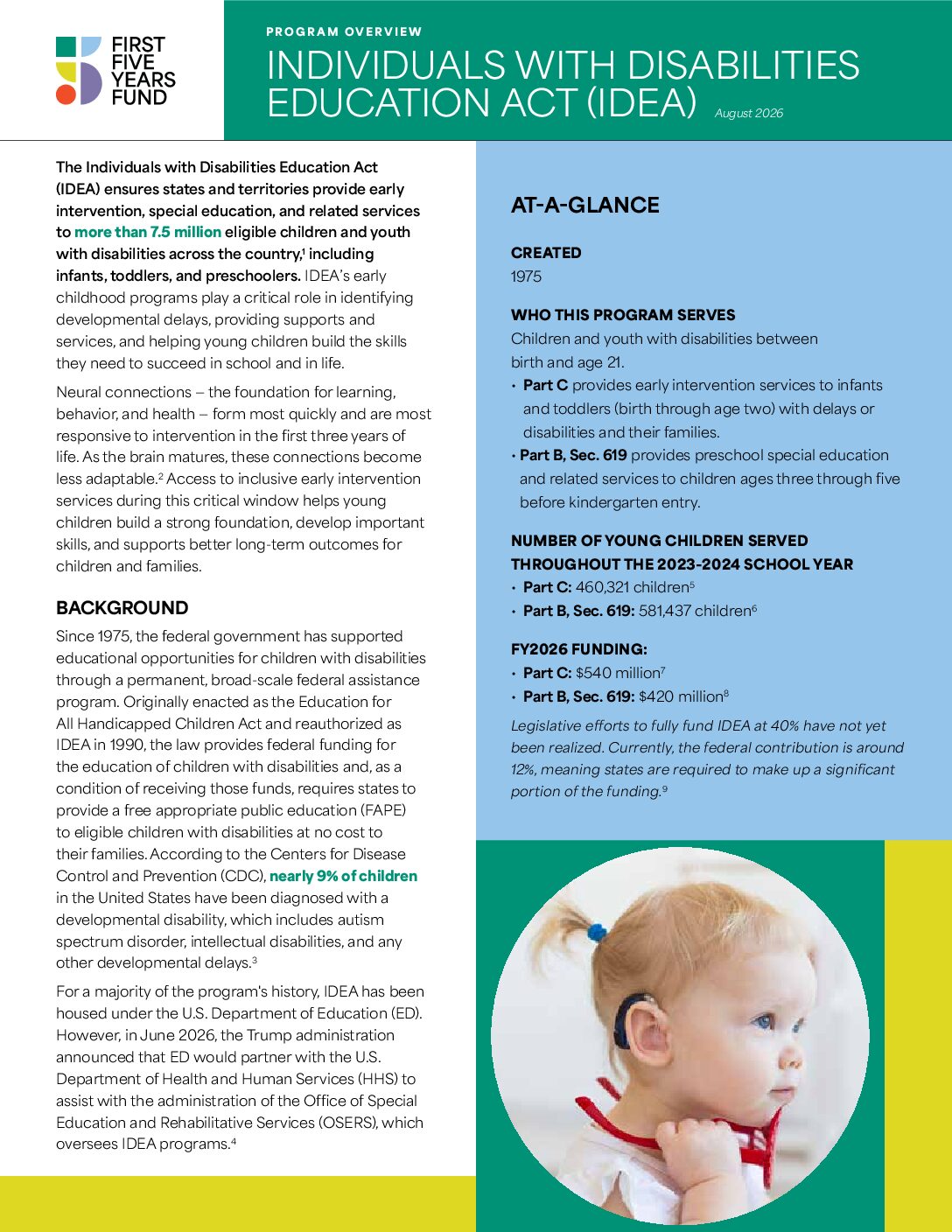
AT A GLANCE
CREATED:
1975
WHO THIS PROGRAM SERVES:
Children and youth with disabilities between birth and age 21.
- Part C provides early intervention services to infants and toddlers (birth through age two) with delays or disabilities and their families.
- Part B, Sec. 619 provides preschool special education and related services to children ages three through five before kindergarten entry.
NUMBER OF YOUNG CHILDREN SERVED THROUGHOUT THE 2023-2024 SCHOOL YEAR:
FY2026 FUNDING:
Legislative efforts to fully fund IDEA at 40% have not yet been realized. Currently, the federal contribution is around 12%, meaning states are required to make up a significant portion of the funding.9
The percentage of children served varies across states, in part because of differences in state eligibility policies, Child Find and outreach efforts, and available resources.10 Despite the proven impact of early intervention, federal IDEA Part C funding per-child has declined over time, placing pressure on state budgets and making it more challenging to ensure equitable access across states.11 Most states supplement federal dollars with state and local funding to serve more children.12
- In the 2023-2024 school year, 4% of children under the age of three received early intervention services.13
- This ranged from more than 10% of children in New Mexico and Massachusetts to less than 2% of children in Arkansas, Mississippi, and Oklahoma.
- In 17 states, more than 5% of children received services.14
- 36 states have eliminated family fees for children receiving early intervention services, reducing financial barriers to access.15
IDEA PART B, SECTION 619
IDEA Part B, Section 619 authorizes supplemental grants to states to provide preschool special education services for children with disabilities. Three-through-five year olds are eligible for early childhood special education (ECSE) if an evaluation determines they have a disability. At the discretion of the state, children who are experiencing developmental delays may also be eligible. While states and public agencies must comply with IDEA requirements, they can make decisions about who is eligible for services, including how to define developmental delays. Nationally, 45% of children receiving ECSE are identified as having a developmental delay, followed by a speech or language disability (36%), and autism (12%).16
States distribute most of the federal grant to Local Educational Agencies (LEAs), that serve children with disabilities in a variety of settings, including public and private preschool programs, Head Start programs, and child care facilities.17 Children typically receive services under Section 619 until they enter kindergarten, at which point they transition to school-age special education and related services under IDEA Part B.
- In the 2023-2024 school year, 5% of preschoolers received ECSE services.18
- This ranged from more than 10% of children in Puerto Rico and Wyoming to less than 3% of children in Alabama, Georgia, and Montana.
- In 31 states, more than 5% of children received services.19
References
- National Center for Education Statistics, “Students With Disabilities,” (2024) ↩︎
- Harvard University Center on the Developing Child, “Brain Architecture” ↩︎
- Centers for Disease Control and Prevention, “Diagnosed Developmental Disabilities in Children Aged 3–17 Years: United States, 2019–2021” ↩︎
- U.S. Department of Education, U.S. Department of Education Announces Additional Partnerships to Strengthen Coordination for Individuals with Disabilities Programs, Bolster Civil Rights Enforcement (June 2026) ↩︎
- U.S. Department of Education, IDEA Section 618 Data Products: Static Tables Part C Child Count and Settings Table 4 (2023-2024) ↩︎
- U.S. Department of Education, IDEA Section 618 Data Products: Static Tables Part B Child Count & Educational Environments Table 2 (2023-2024) ↩︎
- U.S. Department of Education, State Tables by Program, Fiscal Year 2025-2027 President’s Budget (2026 Estimates) ↩︎
- U.S. Department of Education, State Tables by Program, Fiscal Year 2025-2027 President’s Budget (2026 Estimates) ↩︎
- National Education Association, “Individual with Disabilities Education Act (IDEA) Funding Gaps by School District,” (2025) ↩︎
- Prenatal-to-3, “Prenatal-to-3 State Policy Roadmap 2025,” (2025) ↩︎
- Prenatal-to-3, “Prenatal-to-3 State Policy Roadmap 2025,” (2025) ↩︎
- IDEA Infant & Toddler Coordinators Association, “2024 Funding Structure,” (2024) ↩︎
- U.S. Department of Education, “IDEA Section 618 Data Products: Static Tables Part C Child Count and Settings Table 1 – 2023-2024,” (2025). Note: This is determined using a point-in-time approach, which assesses how many children are being served at a specific moment. ↩︎
- U.S. Department of Education, “IDEA Section 618 Data Products: Static Tables Part C Child Count and Settings Table 1 – 2023-2024,” (2025) ↩︎
- Prenatal-to-3, “Prenatal-to-3 State Policy Roadmap 2025,” (2025) ↩︎
- National Institute for Early Education Research (NIEER), “The State(s) of Early Intervention and Early Childhood Special Education: Looking at Equity,” (2023) ↩︎
- U.S. Department of Education, IDEA Preschool Grants for Children with Disabilities (Part B, Sec. 619) ↩︎
- U.S. Department of Education, “IDEA Section 618 Data Products: Static Tables Part B Child Count & Educational Environments Table 7 – 2023-2024,” (2025). Note: This is determined using a point-in-time approach, which assesses how many children are being served at a specific moment. ↩︎
- U.S. Department of Education, “IDEA Section 618 Data Products: Static Tables Part B Child Count & Educational Environments Table 7 – 2023-2024,” (2025) ↩︎
Subscribe to FFYF First Look
Every morning, FFYF reports on the latest child care & early learning news from across the country. Subscribe and take 5 minutes to know what's happening in early childhood education.
Related
FY2027: Community Letter to Appropriators Calls For increased Funding for Child Care and Early Learning
Signed by 87 organizations across 32 states, this letter outlines priorities for the FY27 Appropriations process.

2026: ABCs of Federal Early Learning & Child Care Funding Streams
An overview of the top federal child care and early learning programs and how they are funded.
Overview: White House Budget Request, FY2026
On May 30, the White House released its official budget request for Fiscal Year 2026, with supplemental information following a week later in the Congressional Justification for the newly renamed …