Head Start and Early Head Start: The Program Overview

Head Start is a federally-funded and locally-delivered program that provides early learning, health, and nutrition services to children from the lowest-income families. The program includes Head Start Preschool, which serves children ages 3 to 5, and Early Head Start (EHS), which serves infants and toddlers under age 3, pregnant women, and their families.
CREATION OF PROGRAM
Created in 1965, Head Start has served nearly 40 million children and families throughout its history. Building on decades of research showing Head Start’s short- and long-term benefits, Congress created Early Head Start in the 1994 reauthorization to serve pregnant women and children under age three – a period of rapid development when early support can have lasting effects.
American Indian and Alaska Native (AIAN) Head Start programs serve children in tribal communities and often offer traditional language and cultural practices. Migrant and Seasonal Head Start (MSHS) was created to meet the specific needs of families engaged in migrant and seasonal agricultural work, which often means moving frequently and working long hours during peak seasons. AIAN programs began in 1965, and Migrant and Seasonal Head Start in 1969.
HOW THE PROGRAM WORKS
Head Start funds go directly to local grantees who operate programs in rural, urban, and suburban communities and across a variety of settings. Parents and community members help govern each program, including through Policy Councils, so services fit local needs. Programs provide high-quality early learning and comprehensive services that meet the Head Start Program Performance Standards (HSPPS). Local design allows programs to combine federal, state, local, and private funding for other early learning services to maximize the reach of available funds. Many cities and states have built their early learning systems around Head Start and rely on these grants, paired with other funding sources, to serve children from a variety of backgrounds.
Services are provided to families at no cost. While free or low-cost preschool is available in many states, Early Head Start is often the only source of free early learning services for children under three.
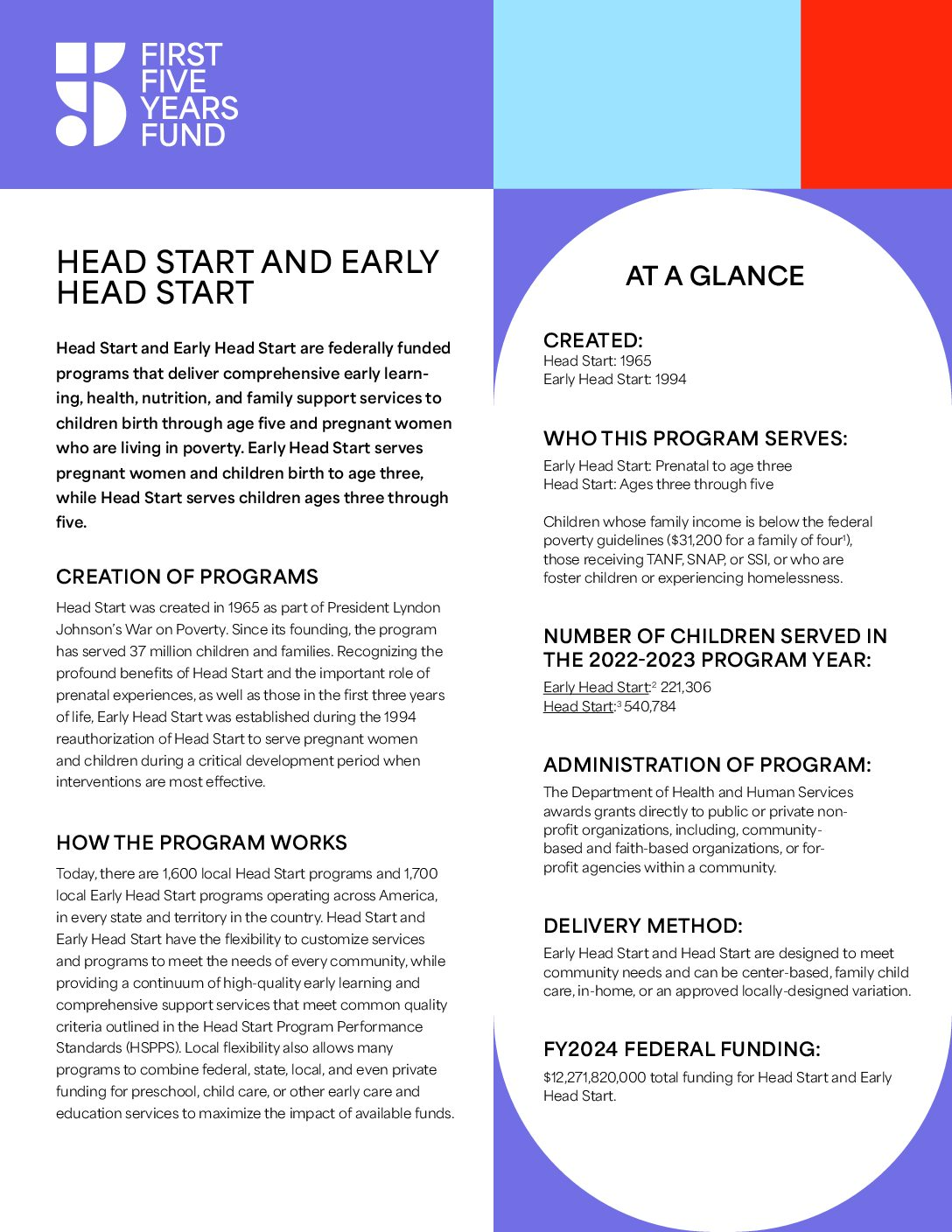
AT-A-GLANCE
CREATED:
Early Head Start: 1994
Head Start Preschool: 1965
WHO THIS PROGRAM SERVES:
Early Head Start: Prenatal to age three
Head Start Preschool: Ages three through five
Children from families with income below the federal poverty line (FPL – $27,320 for a family of three),1 and children whose families receive TANF, SSI, or SNAP or who are in foster care or experiencing homelessness.
Programs must fill at least 10% of funded enrollment with children eligible for services under the Individuals with Disabilities Education Act (IDEA).
Programs may enroll up to 10% of children from families who do not meet these criteria, and up to an additional 35% of children from families with incomes between 100% and 130% of the FPL if they can show they are first meeting the needs of children below the FPL.
NUMBER OF CHILDREN SERVED IN THE 2025 PROGRAM YEAR:2
Early Head Start: 243,175 (includes 4,381 children in AIAN Early Head Start)
Head Start Preschool: 535,921 (includes 13,554 children in AIAN Head Start)
Migrant and Seasonal Head Start: 21,460 (children ages birth to 5)
ADMINISTRATION OF PROGRAM: The U.S. Department of Health and Human Services (HHS), through the Office of Head Start, awards grants directly to local public agencies, private nonprofit organizations (including community-based and faith-based organizations), tribal governments, and for-profit agencies.
DELIVERY METHOD: Head Start programs are designed to meet community needs and can be center-based, home-based, family child care, or an approved locally-designed program option. EHS also serves pregnant women, often through home visits.
FY2026 FEDERAL FUNDING: $12.357 billion for Head Start across all program types, an $85 million increase over FY2025.3
IMPACT ON CHILDREN AND FAMILIES
Head Start is designed to reach children facing the greatest barriers to opportunity: children from the lowest-income households, children with disabilities, children experiencing homelessness, and children in foster care.
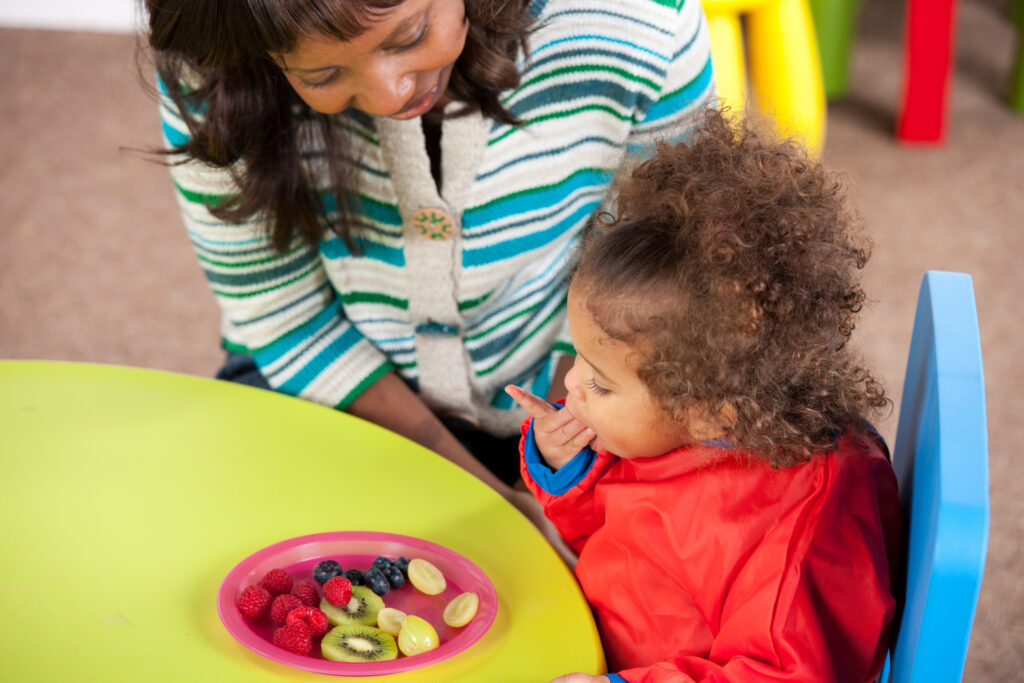
Head Start is designed to support the whole child, which is why comprehensive services sit at the center of the model. While enrolled in Head Start, children receive high-quality early learning and care that builds skills through play and physical activity. Programs also provide healthy meals and snacks, as well as medical, dental, hearing, vision, and behavioral health screenings, and they connect families to follow-up care.
Head Start helps families access services for young children with disabilities. Programs screen every child for developmental concerns and must reserve at least 10% of enrollment for children eligible for IDEA services. Head Start is often where families learn a child is not meeting key developmental milestones and, in some areas, is the only provider able to serve children with developmental delays and disabilities.
Research shows:4
- Children who attend Head Start are more likely to enter kindergarten ready to learn and more likely to graduate high school.
- Head Start families are more engaged in their children’s learning and more likely to advance their own education.
INCREASING ACCESS FOR ELIGIBLE FAMILIES
Despite the well-documented benefits of Head Start and bipartisan support for the program, current funding is insufficient to provide access to all eligible children. In 2025, only 28% of eligible children ages 3-5 had access to Head Start, and just 13% of children eligible for EHS were served by the program.5 Further investment is needed to sustain and expand access for eligible children and families; recruit and retain the qualified teachers and staff needed to support children and their development; allow programs to address pressing local needs, including repair, maintenance, and renovation of facilities; and expand Early Head Start – Child Care Partnerships (EHS-CCP).
Learn More about Head Start, including policy deep dives, state-specific data, and more.
References
- Office of the Assistant Secretary for Planning and Evaluation, “Poverty Guidelines for 2026”. ↩︎
- Office of Head Start, Program Information Report, Program Year 2025. ↩︎
- The Head Start Act (Sec. 640) sets minimum funding shares for certain program types, including AIAN and MSHS programs and Early Head Start; HHS allocates remaining funds by formula and discretion. ↩︎
- National Head Start Association, “Head Start’s Impact”. ↩︎
- First Five Years Fund, “Head Start in the United States 2026 State Fact Sheet”. ↩︎
Subscribe to FFYF First Look
Every morning, FFYF reports on the latest child care & early learning news from across the country. Subscribe and take 5 minutes to know what's happening in early childhood education.
Related
Comments: 2026 Head Start Notice of Proposed Rulemaking
The following comments were submitted electronically by First Five Years Fund to the Administration for Children and Families via www.regulations.gov on October 5, 2026. Re: Comments on Notice of Proposed Rulemaking: …
A Closer Look at HHS’s Head Start Comprehensive Services Data
Head Start is designed to support the whole child and the whole family, which is why comprehensive services are central to the model.

FFYF 2026 Head Start State Fact Sheets
These state fact sheets have data that show the impact of Head Start in all 50 states, including funding, enrollment, unmet need, and the reach of local programs and partnerships.