New Report Outlines Current Challenges for Family Child Care Providers

The National Association for Family Child Care (NAFCC) recently released their 2025-2026 Annual Survey Report, which provides a national snapshot of the current conditions of family child care (FCC) providers.
FCC providers are an essential part of the early childhood workforce. Among the 785 survey respondents, 77% reported having more than a decade of experience in the field, demonstrating deep expertise and long-term commitment. Yet, like other early learning and care providers, they experience an array of challenges that make it difficult to provide quality, affordable care to families. These challenges are exacerbated by the fact that most FCC providers run their businesses alone, with limited external support, infrastructure, or recognition.
The top concerns for FCC providers are depicted in the chart below:
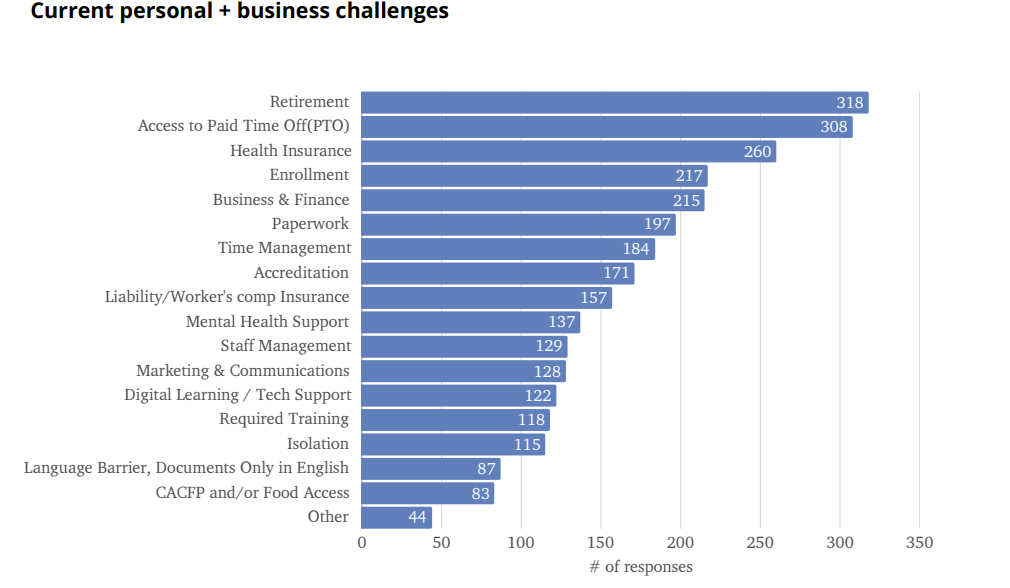
Retirement concerns have remained the top challenge for FCC providers over the years. However, NAFCC has recently found a notable increase in providers reporting concerns about access to benefits and enrollment stability. This shift may reflect higher rates of financial instability, which forces providers to prioritize everyday operating expenses over employee benefits, as well as growing concerns about enrollment volatility due to recent policy changes. Some FCC providers expressed difficulty with the higher demand for infant and toddler care, especially in communities where older children have access to public preschool. Because younger children require lower adult-to-child ratios, FCC providers often lack the personnel to meet this demand, which leads to under-enrollment when other age groups cannot fill these slots. Additionally, providers frequently describe disruptions in child care subsidy access as a challenge that limits families’ ability to enroll even when care is available.
FCC providers this year also cited challenges with the administrative burden and cost of meeting oversight and monitoring requirements through technology. Technology use has become integral to running a child care business, and FCC providers must navigate requirements across multiple public programs and regulatory bodies: 78% of respondents participate with child care subsidy programs, and 76% participate in the Child and Adult Care Food Program (CACFP). Providers expressed difficulty affording the child care management software that is necessary to meet various regulatory and reporting requirements, especially since these expenses fall solely on them as small business owners.
Overall, the survey emphasizes the mounting financial and administrative hurdles challenging the long-term sustainability of FCC providers, who play an essential role in supporting children, families, and local economies. These highly-skilled and experienced providers currently operate within systems that do not fully account for the reality of their sole proprietorship. To guard against further loss of this vital source of affordable, flexible care for families, NAFCC calls for an increase in sustained investment and policy considerations that include FCC.
Subscribe to FFYF First Look
Every morning, FFYF reports on the latest child care & early learning news from across the country. Subscribe and take 5 minutes to know what's happening in early childhood education.
Related

Reintroduction of Bills Offering Needed Updates to Child Care Food Assistance Program
Access to nutritious food is essential to children’s healthy growth and development, and child care is a prime opportunity for children to receive the nutritious meals and snacks they need …

Bills Offer Needed Updates to Child Care Food Assistance Program
Having access to nutritious food is essential to children’s healthy growth and development, and children in full-time care need multiple meals and snacks throughout the day. With the cost of …

Bipartisan Child Care Town Hall with Representatives Bonamici and Hinson
WASHINGTON, D.C. – The First Five Years Fund (FFYF) hosted Congresswomen Suzanne Bonamici (D-OR) and Ashley Hinson (R-IA) for a town hall to discuss the importance of child care in their …