How 45F Helps Employers Strengthen Child Care Options

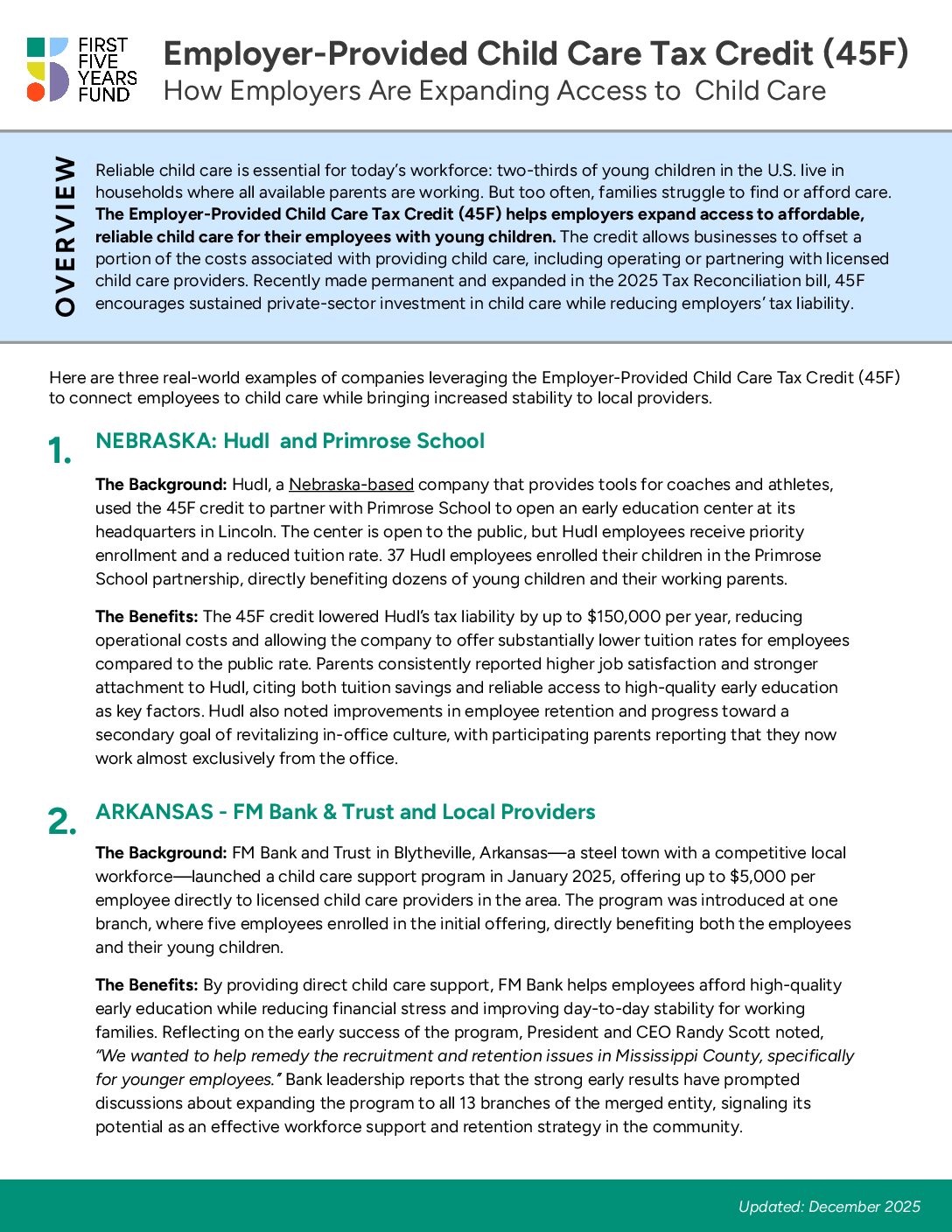
Reliable child care is essential for today’s workforce: two-thirds of young children in the U.S. live in households where all available parents are working. But too often, families struggle to find or afford care. The Employer-Provided Child Care Tax Credit (45F) helps employers expand access to affordable, reliable child care for their employees with young children.
The credit allows businesses to offset a portion of the costs associated with providing child care, including operating or partnering with licensed child care providers. Recently made permanent and expanded in the 2025 Tax Reconciliation bill, 45F encourages sustained private-sector investment in child care while reducing employers’ tax liability.
Here are three real-world examples of companies leveraging the Employer-Provided Child Care Tax Credit (45F) to connect employees to child care while bringing increased stability to local providers.
1. NEBRASKA: Hudl and Primrose School
The Background: Hudl, a Nebraska-based company that provides tools for coaches and athletes, used the 45F credit to partner with Primrose School to open an early education center at its headquarters in Lincoln. The center is open to the public, but Hudl employees receive priority enrollment and a reduced tuition rate. 37 Hudl employees enrolled their children in the Primrose School partnership, directly benefiting dozens of young children and their working parents.
The Benefits: The 45F credit lowered Hudl’s tax liability by up to $150,000 per year, reducing operational costs and allowing the company to offer substantially lower tuition rates for employees compared to the public rate. Parents consistently reported higher job satisfaction and stronger attachment to Hudl, citing both tuition savings and reliable access to high-quality early education as key factors. Hudl also noted improvements in employee retention and progress toward a secondary goal of revitalizing in-office culture, with participating parents reporting that they now work almost exclusively from the office.
2. ARKANSAS – FM Bank & Trust and Local Providers
The Background: FM Bank and Trust in Blytheville, Arkansas—a steel town with a competitive local workforce—launched a child care support program in January 2025, offering up to $5,000 per employee directly to licensed child care providers in the area. The program was introduced at one branch, where five employees enrolled in the initial offering, directly benefiting both the employees and their young children.
The Benefits: By providing direct child care support, FM Bank helps employees afford high-quality early education while reducing financial stress and improving day-to-day stability for working families. Reflecting on the early success of the program, President and CEO Randy Scott noted, “We wanted to help remedy the recruitment and retention issues in Mississippi County, specifically for younger employees.” Bank leadership reports that the strong early results have prompted discussions about expanding the program to all 13 branches of the merged entity, signaling its potential as an effective workforce support and retention strategy in the community.
3. IOWA: Frontier Co-Op and On-Site Care
The Background: Frontier Co-op, headquartered in Norway, Iowa, is a member-owned cooperative that manufactures and sells herbs and spices. In the 1980s, Frontier Co-op established an on-site child care center for employees’ children. Today, Frontier Co-op utilizes the 45F tax credit and subsidizes a portion of child care costs for employees, with families paying roughly $110–$115 per week per child for on-site care. The cooperative also offers a partial reimbursement option for employees who use licensed providers outside the center. The center operates from 7 a.m. to 6 p.m., allowing parents to bring their children to work with them and pick them up at the end of the day.
The Benefits: With a workforce largely made up of manufacturing employees and farming families, access to reliable child care has long been a challenge in the community. Today, the center is licensed for up to 120 children and operates and nearly full capacity. With the recent expansion of 45F, the co-op is now thinking about expanding the center to serve even more working families. According to Frontier, “Many of Frontier Co-op’s early employees were farming families with parents out in the fields, leaving primary caregivers who needed to go to work with few child care options. Parents often had to bring their children to work, which led the company to create a child care center, and today the 45F tax credit helps make it possible to sustain and expand that kind of support for working families.”
How Employers Use 45F
Employers can use the 45F child tax credit in several ways, including:
- Contracting with a local provider to offer child care for employees’ children;
- Building or operating an on-site child care center for employees;
- Partnering with third-party intermediaries to contract with qualified child care providers.
The Corporate Bottom Line
45F offers a direct reduction of a tax bill for businesses.
- A large business can reduce their tax bill by up to $500,000 (or 40% of eligible expenses up to the maximum claim.)
- A small business can reduce their tax bill by up to $600,000 (or 40% of eligible expenses up to the maximum claim.)
- Businesses large and small report improved employee recruitment and retention, increased productivity, and overall employee satisfaction when child care support is offered to employees.
Learn More
- 45F Overview – A deep dive into how 45F works and how the newly expanded credit
- The First Five Things To Know About 45F: A topline look at 45F and the impact it has on employers, parents, and communities.
- How 45F Helps Employers Strengthen Child Care Options – A link to stories of employers leveraing 45F to connect employees to child care.
Print friendly version
Subscribe to FFYF First Look
Every morning, FFYF reports on the latest child care & early learning news from across the country. Subscribe and take 5 minutes to know what's happening in early childhood education.
Related

A Year of Progress: 10 Bright Spots for Child Care & Early Learning
Even in a year marked by a government shutdown, political turbulence, and general unpredictability in Washington, 2025 gave us plenty to celebrate for child care and early learning. Families, advocates, …

The First Five Things to Know About: Employer-Provided Child Care Credit (45F)
In the United States, two-thirds of young children live in households where all available parents are working. meaning child care is essential for families’ ability to stay in the workforce. …

Employer-Provided Child Care Credit (45F): Overview
The Employer-Provided Child Care Credit, also known as 45F, is one way to address the needs of both working parents and employers. Under 45F, employers receive a tax credit for …