New Survey Emphasizes How Child Care Affordability Challenges Destabilize Both Providers and Families

Even as the demand for child care remains high, escalating operational costs and staffing challenges prevent providers from being able to maintain and increase program enrollment, making it harder for families to find and afford care.
The annual early childhood education workforce survey from the National Association for the Education of Young Children (NAEYC) found that the 2025 program year was especially challenging for providers and families. The survey highlighted increased reports of persistent issues in the field, such as educator burnout and enrollment challenges, as well as an affordability crisis driven by rapidly rising costs for both providers and families. In addition to a national brief, NAEYC released state by state survey briefs with state-specific data and quotes from educators on rising costs, burnout, and closures.
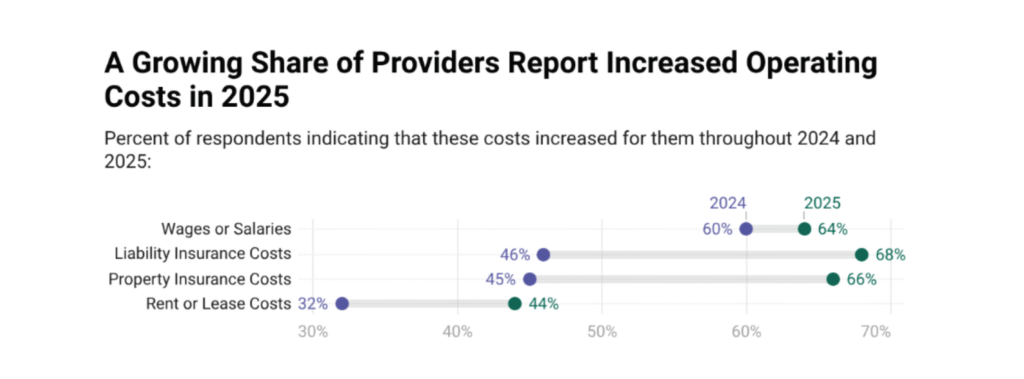
The survey found that the cost of operating a child care program rose drastically in 2025, further constraining providers who were already operating on razor-thin margins. While educators have reported increased costs fairly consistently in past years, this new survey observed sizable jumps in the percentage of respondents reporting increases in costs over several key categories.
These increases are depicted below:
As program costs continue to rise without sufficient public investment to fill the gap, providers face difficult decisions about how to offset those costs. Often, they must decide whether to shoulder the burden and risk business instability in an already strained market, or to pass the burden on to families in the form of higher tuition, which may jeopardize enrollment if families are unable to afford new rates.
Across settings, the survey found that respondents from 65% of child care centers, 51% of public school-based programs, and 31% of home-based programs reported passing at least some of these costs on to families by raising tuition over the last year. This trend is especially concerning given that nearly half of respondents reported that their programs were not enrolled at the desired capacity, citing family affordability and staffing challenges as the primary causes. In particular, more than half of program leaders indicated an increase in the number of families who withdrew from their program because they lost their subsidy or could not afford tuition. Respondents also reported increased difficulty recruiting and retaining qualified staff, driven in part by challenges offering sufficient compensation and the need for remaining staff to take on heavier workloads.
FFYF Takeaway:
Overall, the results of this survey point to an affordability crisis impacting both the early childhood field and the families it serves, underscoring the need for sustainable public investments to ease these burdens. Without sufficient funding, program leaders are trapped in a difficult cycle: to stay afloat they must raise rates and/or cut costs, yet both actions undermine the stability of their operations and ability to provide affordable, quality care for families.
Subscribe to FFYF First Look
Every morning, FFYF reports on the latest child care & early learning news from across the country. Subscribe and take 5 minutes to know what's happening in early childhood education.
Related

The Friday Five: The Latest Child Care and Early Learning News
The child care and early learning news you don’t want to miss. Check here for updates every Friday for the latest information you need to know.

Head Start and Early Head Start: The Program Overview
This one-pager provides data and information on how Head Start works and who it serves.

Making News: MIECHV Grants, 2026
MIECHV is making headlines! The Maternal, Infant, and Early Childhood Home Visiting (MIECHV) program provides federal funding to states to use to pair families with very young children with trained …