NIEER’s New State of Preschool Yearbook Highlights State Progress and Challenges
The National Institute for Early Education Research (NIEER) released their 2025 State of Preschool Yearbook, which offers a comprehensive analysis of state-funded preschool programs during the 2024-2025 school year.
Currently in its 23rd edition, this report continues to serve as a crucial resource for policymakers, educators, and advocates, providing data-driven insights into enrollment trends, funding levels, and quality standards across the U.S.
Overview
The 2024-2025 school year represented another year of record highs in state support for preschool enrollment, quality, and funding. However, the pace of this growth significantly slowed from the 2023-2024 school year. The Yearbook provides key information that highlights the importance of federal early childhood funding in states, encourages policymakers to create policies that will preserve and increase investment, and highlights state progress and challenges.
Key Takeaways
Enrollment:
- Enrollment reached a new high of nearly 1.8 million children during the 2024-2025 school year.
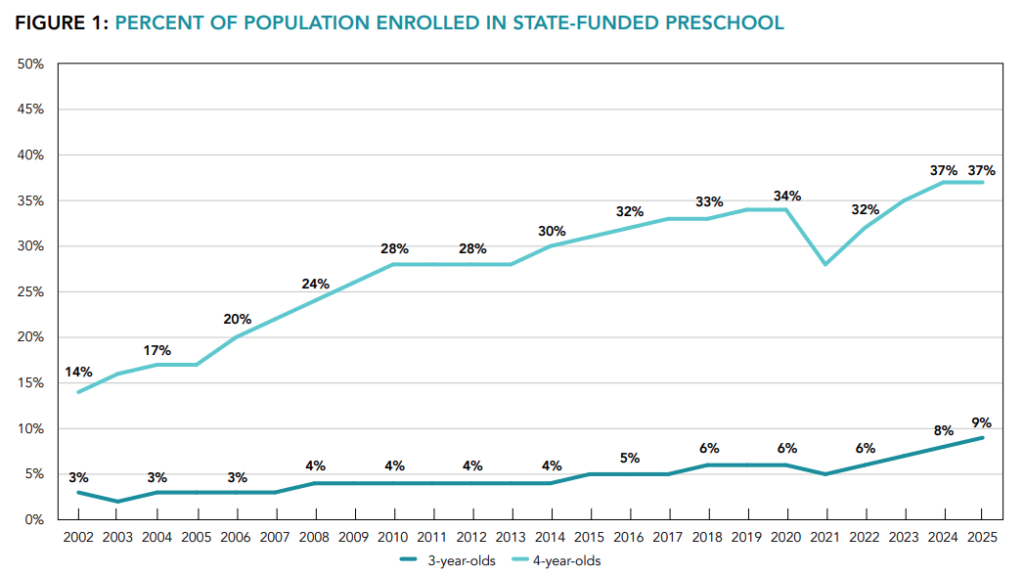
- National enrollment for four-year-olds increased by 44,000 children in this school year, though the percentage remained the same as the previous year at 37%.
- National enrollment of three-year-olds increased by 8,000 children, bringing the percentage up to 9%.
- 12 states enrolled more than 50% of their four-year-olds in state-funded preschool.
Funding:
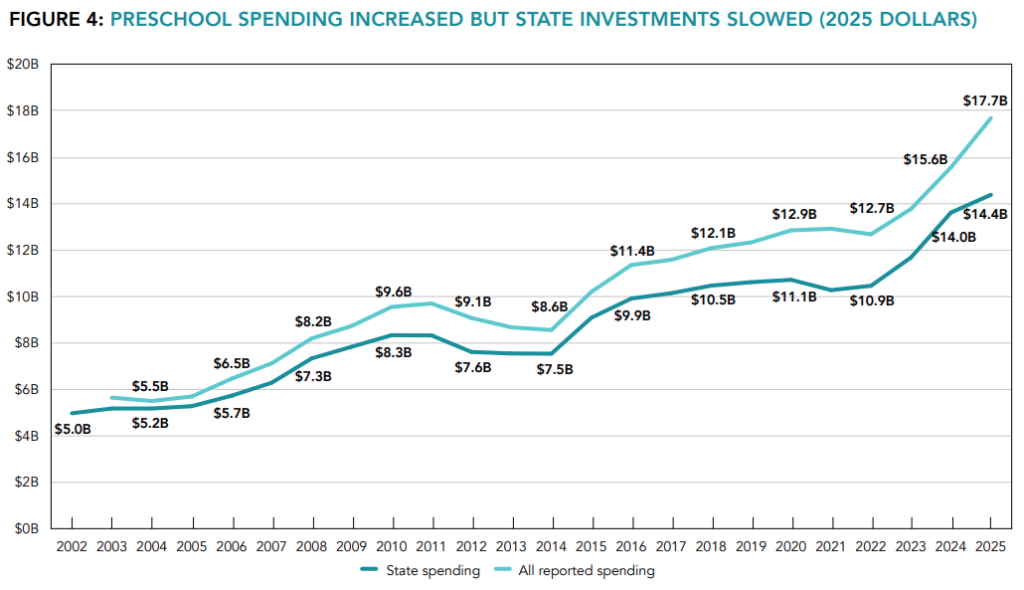
- State preschool funding also reached a new high with states spending nearly $14.4 billion, an inflation-adjusted increase of $434 million (3%).
- All reported funding (state, local, and federal) in support of state preschool reached a high of nearly $17.7 billion, an inflation-adjusted increase of $2 billion (14%).
- State spending per child enrolled averaged $8,124, an inflation-adjusted increase of $45 per child.
- 28 states increased spending per child, adjusted for inflation.
Quality:
- A record six states met all 10 of NIEER’s quality standards benchmarks: Alabama, Georgia, Hawaii, Michigan, Mississippi, and Rhode Island.
- Georgia became the newest state to enter this category by lowering their class sizes from 22 to 20 and improving their teacher-to-child ratios from 1:11 to 1:10, it is also the first state offering universal pre-K to meet this milestone.
- Another eight states met nine of NIEER’s quality standards benchmarks and 21% of children in state-funded preschool are enrolled in programs that meet nine or 10 benchmarks.
- 20 states still meet five or fewer of these quality standards benchmarks, these 20 programs serve 46% of children in state-funded preschool.
FFYF Takeaway
State-funded preschool programs are an important part of states’ early learning and care systems. State spending is steadily increasing, and non-state spending is increasing at a higher rate. While overall progress is important, the Yearbook found that this progress was not even among states. Some states made remarkable strides, while others remained stagnant or even slid backwards. Increased and sustained investment is necessary to improve quality and long-term outcomes nationwide.
Subscribe to FFYF First Look
Every morning, FFYF reports on the latest child care & early learning news from across the country. Subscribe and take 5 minutes to know what's happening in early childhood education.
Related

The Friday Five: The Latest Child Care and Early Learning News
The child care and early learning news you don’t want to miss. Check here for updates every Friday for the latest information you need to know.

Head Start and Early Head Start: The Program Overview
This one-pager provides data and information on how Head Start works and who it serves.
Making News: MIECHV Grants, 2026
MIECHV is making headlines! The Maternal, Infant, and Early Childhood Home Visiting (MIECHV) program provides federal funding to states to use to pair families with very young children with trained …