Frequently Asked Questions: 2026 Head Start NPRM

On August 7, 2026, the Administration for Children and Families (ACF) released a Notice of Proposed Rulemaking (NPRM) on Head Start – a formal announcement published in the Federal Register when a federal agency intends to add to, remove from, or otherwise change policy through a rule or regulation. The proposal, Reducing Federal Burden for Head Start Programs (RIN 0970-AD30), would replace the current Head Start Program Performance Standards with a significantly shorter set of federal regulations, touching nearly every part of the program – from health and safety to staffing, eligibility, and governance.
FFYF has heard directly from providers, parents, and advocates with questions about what this proposal would actually mean for Head Start programs and the children and families they serve. We’ve compiled those questions here, along with clear, straightforward answers – including what would change, what would stay the same, and what’s still required under the Head Start Act regardless of this rulemaking.
The below FAQ includes questions on:
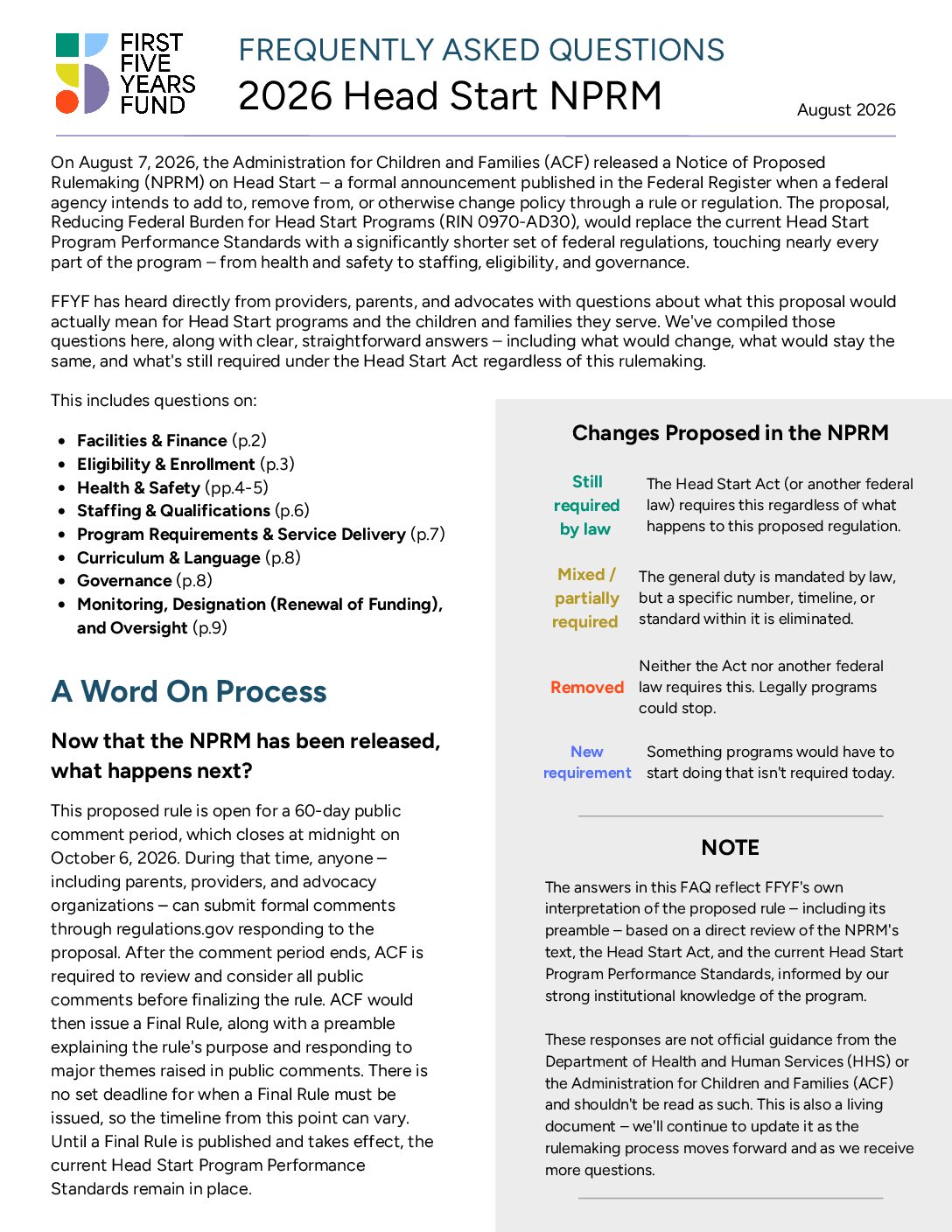
Key: Changes Proposed in the NPRM
| Statute Stands | The Head Start Act (or another federal law) requires this regardless of what happens to this proposed regulation. |
| Statute Stands / Regulation Cut | The general duty would be mandated by law, but a specific number, timeline, or standard within it would be eliminated. |
| Requirement Removed | Neither the Act nor another federal law requires this. Legally programs could stop. |
| New Requirement | Something programs would have to start doing that isn’t required today. |
A Word On Process
Now that the NPRM has been released, what happens next?
This proposed rule is open for a 60-day public comment period, which closes at midnight on October 6, 2026. During that time, anyone – including parents, providers, and advocacy organizations – can submit formal comments through regulations.gov responding to the proposal. After the comment period ends, ACF is required to review and consider all public comments before finalizing the rule. ACF would then issue a Final Rule, along with a preamble explaining the rule’s purpose and responding to major themes raised in public comments. There is no set deadline for when a Final Rule must be issued, so the timeline from this point can vary. Until a Final Rule is published and takes effect, the current Head Start Program Performance Standards remain in place.
NOTE
The answers in this FAQ reflect FFYF’s own interpretation of the proposed rule – including its preamble – based on a direct review of the NPRM’s text, the Head Start Act, and the current Head Start Program Performance Standards, informed by our strong institutional knowledge of the program.
These responses are not official guidance from the U.S. Department of Health and Human Services (HHS) or the Administration for Children and Families (ACF) and shouldn’t be read as such. This is a living document – we’ll continue to update it as the rulemaking process moves forward and as we receive more questions.
Facilities & Finance
Could a program still spend federal funds on services no longer required by the HSPPS?
Federal cost rules (2 CFR Part 200) allow a program to keep funding an activity as long as it’s a reasonable, allowable use of the grant – that doesn’t depend on whether Parts 1301–1305 specifically requires it. The NPRM’s preamble says: for things like bus monitors, screening timelines, and monthly mental health consultation, programs “may choose to continue” offering them. The exceptions are provisions that don’t just remove a requirement but replace it with a rule that funding the old practice would violate:
- English-only instruction (proposed § 1301.04(a)): classroom instruction must now be in English, so continuing to fund dual-language instruction or materials would require an HHS-approved waiver.
- Staff credential incentives (proposed § 1301.12(c)): programs can’t require or incentivize postsecondary credentials for staff unless they can justify it’s necessary for the job.
- The 5% administrative cost cap: a hard ceiling – administrative costs above that can’t be charged to Head Start funds at all.
So most removed requirements become optional-but-still-fundable. A few become genuinely restricted. [Mixed – depends on provision]
Does the NPRM change the cap on administrative spending?
Yes. The current cap is 15% of total approved program costs, and the proposed rule would cut that to 5%. This proposed change differs from most items in the NPRM: the Head Start Act includes the 15% figure but doesn’t guarantee programs the right to spend up to that amount. The statute gives the Secretary three specific tools:
- Defining the accounting criteria for what counts as an administrative cost versus a total cost;
- Ordering an individual program below 15% if the Secretary judges that program’s costs “excessive” even under the cap; and
- Granting time-limited waivers (up to 12 months) allowing an individual program to exceed 15%.
None of these amounts to a general rulemaking power to replace 15% with a new number for every Head Start agency. A 5% cap would stay under that ceiling, so it wouldn’t conflict with the law, though it would go much further than the law requires. [Statute Stands / Regulation Cut]
How was the new proposed cap on admin expenses decided and why?
The main support for this change is a comparison to four other HHS programs that use a 5% cap – Child Care and Development Fund (CCDF), the Substance Use Prevention and Treatment Block Grant, the Community Mental Health Services Block Grant, and the Community Services Block Grant. All four are federal block grants to states, where much of the administrative burden – eligibility systems, compliance monitoring, reporting – sits with state administrators. Head Start, though also a federal grant, works differently – funding flows directly from ACF to local grantees, who cover all administrative burden themselves. That structural difference distinguishes Head Start from the programs ACF cites as comparators.
ACF’s Regulatory Impact Analysis (RIA) also presents data on current Head Start spending as part of its justification. It reports that approximately 3.7% of Head Start grants currently operate at or below a 5% administrative cost threshold – meaning the proposed cap reflects where a small minority of programs already are. An additional 7.9% currently spend between 5% and 7.5%, and 19.8% spend between 7.5% and 10%. ACF acknowledges directly that “relatively few grants currently operate at or below the proposed 5 percent cap.” Elsewhere in the same analysis, ACF also notes many programs already operate “closer to a 10 percent” cap than to 15%. [Statute Stands / Regulation Cut]
What would happen to the detailed facility-purchase and procurement rules?
Most of the detailed requirements around purchasing, renovating, and protecting the federal interest in Head Start facilities would be eliminated, replaced with a much shorter process. Most of the current detail isn’t required by the Head Start Act. [Regulation Removed]
Eligibility & Enrollment
Would families still be able to self-attest to their income if they don’t have documentation?
No. The proposed rule would eliminate the current option to accept a family’s signed declaration when income documentation isn’t available. Families would need to provide documentation. [New Requirement]
How would the proposed change to self-attestation affect verifying eligibility for children experiencing homelessness under McKinney-Vento?
Head Start currently uses the McKinney-Vento Act’s definition of homelessness (a lack of fixed, regular adequate nighttime residence and encompassing living in shelters, motels, cars, couch surfing,) to identify which children qualify, and the Head Start Act deems those children automatically eligible (Sec. 645(a)(1)(B)(ii)) – no income documentation required. To make that workable, current rules let programs accept a family’s signed statement when they can’t provide paperwork like a lease or utility bill, since homelessness itself often means lacking that kind of documentation. The proposed rule would end self-attestation without a carve-out exception for this group. This could make it harder to verify eligibility for children experiencing homelessness, since the same circumstances that qualify a child under this category often make standard documentation hard to produce. [Regulation Removed]
Would programs still have to assess their community’s needs before making decisions?
The Head Start Act does not contain language requiring programs to conduct a needs assessment, but it does require programs to use and share an annually updated community needs assessment for several purposes (Sec. 642(d)(2)(G)): converting program slots, expanding services, federal monitoring, and technical assistance planning. The proposed rule’s preamble states that “the Act clearly requires use of a community needs assessment.” The NPRM would eliminate the specific federal requirements of what a community needs assessment must include, how often it’s updated, and how detailed it must be. The underlying obligation to maintain and use a community needs assessment would remain, but there would no longer be a federal standard for what it should contain. [Statute Stands / Regulation Cut]
Would the federal recruitment and selection procedures for enrolling children be eliminated?
The specific steps programs currently follow for recruiting and selecting children would be eliminated. Current regulation requires programs to make active recruitment efforts specifically targeting children with disabilities and other children in need, including children experiencing homelessness and children in foster care. It also requires programs to annually establish selection criteria – tied directly to the community needs assessment – that weigh specific factors: family income, homelessness, foster care status, age, Individuals with Disabilities Education Act (IDEA) eligibility, and other family or child risk factors, along with additional priority rules for Tribal programs and migrant/seasonal programs, and a standing prohibition on denying enrollment because of a disability. All these details would be eliminated.
One related provision: current regulation also implements the Act’s requirement that at least 10% of a program’s funded enrollment be filled by children eligible for services under IDEA. That regulatory implementation would also be eliminated. The 10% figure would remain legally binding by statute regardless, but ACF’s preamble acknowledges that removing the regulation leaves a gap, and states that ACF “expect[s] guidance” on the 10% requirement to follow separately, outside the normal public comment process.
The Act still requires programs to have selection criteria in general terms, but the detailed regulatory process – what those criteria must weigh, how often they’re revisited, and the specific protected categories – would be eliminated. [Regulation Removed]
Health & Safety
Would children still get required health, vision, hearing, and dental screenings?
The Head Start Act requires agencies to use research-based, validated developmental screening tools as part of meeting the program’s overall school-readiness standards (Sec. 642(f)(6)) – but that’s a duty to have and use screening tools, not an explicit requirement that every enrolled child actually be screened, and the Act sets no timeline. The Act’s only child-specific screening trigger is narrow, it applies solely to Early Head Start, and only after a child already has a documented behavioral problem (Sec. 645A(b)(6)) – it isn’t a universal check for infants, toddlers, or preschoolers.
The NPRM would eliminate the part that guarantees screenings occur – that every enrolled child gets health, vision, hearing, and developmental screenings, completed within 45 or 90 days of enrollment. Because of the way the Act is worded, without that regulation, a program could satisfy the statute while never systematically screening most children.
Separately, most Head Start children are also eligible for Medicaid, and Medicaid’s own Early and Periodic Screening, Diagnostic, and Treatment (EPSDT) benefit independently guarantees periodic screenings regardless of anything in this rule – though EPSDT coverage doesn’t come with Head Start’s enrollment-linked timeline, and follow-through depends on families’ Medicaid access. [Regulation Removed]
Would monthly mental health consultations for Head Start staff be eliminated?
Yes. The current requirement that programs secure mental health consultation services at a frequency of at least once a month – which covers both children’s needs and staff/adult mental health and wellness support – would be removed, with nothing to replace it. Programs would still be “permitted and encouraged” to maintain regular mental health consultation if they choose to, and general statutory duties around staff wellness and children’s mental health supports remain – but the specific monthly requirement, and the guarantee that consultation happens at all, would become optional. [Regulation Removed]
Would suspension and expulsion protections be eliminated?
Yes. Current limits on suspending a child for behavior, the prohibition on expelling a child, and the requirement to consult a mental health professional before any suspension would all be eliminated. The Act has a narrow requirement for EHS programs to screen and refer children with documented behavioral problems, but no general suspension/expulsion rule for Head Start Preschool. Under the proposed rule, programs would determine their own disciplinary policies within the context of state and local licensing requirements. [Regulation Removed]
What would happen to the required staff-to-child ratios?
The specific federal ratios (for example, no more than 8 infants/toddlers per 2 teachers) would be eliminated. The proposed rule instead would require programs to publish a group size and ratio that is “consistent with” state and local law – meaning state law becomes the floor a program can’t fall below, not a target it has to match. The Head Start Act itself has never set ratios – they have only ever existed in regulation. Most states have their own ratio requirements through a separate federal funding stream (CCDF) and state licensing, so most programs would still have some ratio floor, just not a Head Start-specific one. With this proposed change, a regulatory gap would open for programs exempt from state child care licensing – roughly a quarter of Head Start sites – where it would not be clear if a numeric floor would still apply.
Additionally, the statute (42 U.S.C. § 9836a(a)(2)(C)(ii)) requires the Secretary, when revising performance standards, to ensure the revisions don’t eliminate or reduce the quality, scope, or types of services required under the standards in effect on December 12, 2007. Group size and ratio requirements predate that baseline. Eliminating the federal ratio floor entirely, rather than modifying it, raises a question about whether this satisfies that requirement. [Statute Stands / Regulation Cut]
How would this affect Head Start following the same quality standards nationwide?
Since state ratios vary considerably, this could mean real differences in what Head Start looks like depending on where a family lives. For example, in Maine and New York 4- and 5-year-old classrooms are capped at 8 children per staff member, while North Carolina and Florida allow up to 20 –a two-and-one-half-fold difference. Under the proposed rule, two children enrolled in programs both called “Head Start” could experience very different staff-to-child ratios depending on their state’s floor and each program’s own choices. Nothing in the NPRM would require a program to adopt its state’s maximum, but nothing would require it to stay below that maximum either. [Statute Stands / Regulation Cut]
Would the proposed change to ratios affect each program’s funded enrollment?
There is currently no indication that funded enrollment would be affected. A program’s funded enrollment – the number of children its grant is designed to serve – is set through the grant award process, not through regulation. Under standard grant funding mechanics, the dollar amount awarded should not vary depending on program ratios. According to this NPRM, a program should be able to adopt a looser ratio, keep its current ratio, or choose anything in between, and retain its funded enrollment as negotiated in in the program’s Notice of Award (NOA). [General Q & A – No applicable tag]
How are the requirements for criminal background checks changing?
The NPRM would eliminate several federal requirements related to criminal background checks, such as the current requirement to conduct subsequent background checks every five years after the initial background check. However, the Head Start Act itself requires only that programs obtain a state, tribal, or federal criminal record check before hiring staff. The additional current requirement to conduct interviews and verify references goes beyond what the Act requires and comes from regulation alone. Programs would continue to be required to comply with all other applicable federal, state, tribal, and local laws governing criminal background screening, including requirements under the Child Care and Development Block Grant Act. [Statute Stands / Regulation Cut]
Staffing & Qualifications
Would Head Start teachers still need specific degrees or credentials?
The Head Start Act itself sets two specific targets that remain legally binding regardless of this proposed rule: EHS teachers must hold at least a Child Development Associate credential, and at least half of Head Start Preschool teachers nationwide must hold a bachelor’s degree, with all center-based teachers holding at least an associate’s degree. The regulation that implements and tracks compliance with those targets would be removed. The legal requirements would remain, but the federal mechanism for enforcing and monitoring would be eliminated. [Statute Stands]
What would the qualification requirements be for other positions – directors, home visitors, family services staff?
These would be eliminated. The Head Start Act doesn’t set qualification standards for these specific positions; the current detailed requirements were added by regulation beyond what the law requires, and the proposed rule would remove them entirely, leaving qualification decisions to individual programs. [Regulation Removed]
Does the NPRM include anything that would change hiring practices?
Yes – the NPRM would newly bar programs from requiring or favoring a postsecondary credential in hiring unless the program could justify why the requirement is necessary. This restriction doesn’t exist in current regulation. [New Requirement]
What does the proposed rule say about required training hours and coaching for staff?
The Act requires at least 15 clock hours of professional development annually for classroom teachers – that specific number remains legally binding. Everything beyond that – new staff orientation, the structured coaching and assessment process, training on social-emotional development – is not included in the Head Start Act and would be eliminated entirely. [Statute Stands / Regulation Cut]
Program Requirements & Service Delivery
How would the NPRM affect current duration-of-service requirements?
This would work differently depending on program type. The NPRM would reduce the federal duration-of-service requirements for Head Start Preschool programs. For center-based Preschool programs, current regulation requires a minimum of 3.5 hours per day; the proposed rule would allow programs to align with the statutory floor and revert to the 1994-era minimum of 3 hours per day. That statutory floor, set by Sec. 640(k)(1) of the Act, also protects the number of service days – at least 128 days per year for programs operating four days a week, or 160 days per year for programs operating five days a week – but current regulation already sits at that same 1994 baseline for days, so the days requirement is already at that legal floor and wouldn’t change. Only the hours-per-day minimum would be reduced.
For EHS center-based programs and Family Child Care programs, the NPRM would eliminate the current 1,380-hour annual requirement and rely instead on the Act’s requirement that programs provide “early, continuous, intensive, and comprehensive” child development and family support services (Sec. 645A(b)(1)).
ACF has long interpreted this language to mean full-day, year-round services, though that interpretation is not written into the statute or codified as a specific hour count, so programs would have flexibility to design schedules based on community needs.
ACF’s stated goal is to give programs flexibility to set schedules based on local needs; programs may also choose to keep their current hours. [Statute Stands / Regulation Cut]
How would the proposed changes affect the relationship between Head Start and the Maternal, Infant, and Early Childhood Home Visiting (MIECHV) program?
MIECHV and Head Start are separate federal programs, and these proposed changes wouldn’t affect MIECHV’s own eligibility or funding requirements. However, the NPRM would eliminate the federal requirements governing EHS home-based services, including the frequency and duration of home visits, group socializations, and home visitor caseloads – currently a required caseload of 10 to 12 families per home visitor, with a maximum of 12 – as these provisions are contained only in regulation. Programs could choose to reduce the number or length of home visits, which could result in larger caseloads and fewer home-visiting staff.
Because MIECHV funding must support evidence-based home-visiting models with their own fidelity requirements (meaning strict adherence to that model’s specific, evidence-based practices), any changes an EHS program makes to its home-visiting practices could affect how well the two programs coordinate where they operate jointly. This matters most in communities where the two programs share infrastructure rather than operate as separate systems. For example, there are communities where the same home visitors serve both EHS- and MIECHV-funded families. A shared home visitor’s EHS caseload could grow under this proposed rule, while their MIECHV caseload stays fixed – creating a capacity constraint. MIECHV’s standards are also established by law and can’t be relaxed without risking that program’s own funding. These examples are inferences based on how EHS and MIECHV typically interact operationally, not something the NPRM addresses directly. [Regulation Removed]
How would the proposed nutrition provisions interact with the existing requirement for Head Start programs to participate in Child and Adult Care Food Program (CACFP)?
The NPRM would not change anything of substance; it’s a shorter regulatory restatement of something that continues either way, because it comes from USDA’s own program rules, not from Head Start’s. Under the proposed rule, programs would continue to be required to use USDA Child Nutrition programs (including CACFP) as the primary funding source for meals and snacks, using Head Start funds only for costs USDA doesn’t cover. The proposed nutrition standard (new §1301.07) would require programs to serve nutrient-dense, whole foods consistent with a healthy diet that conforms to USDA’s own CACFP meal-pattern requirements (7 CFR Part 226) – the same standard programs already meet as CACFP participants. [Statute Stands]
Curriculum & Language
Would programs still have to use a research-based curriculum?
Yes. The Head Start Act itself requires agencies to implement a standardized, research-based curriculum (Sec. 642(f)(3)). The regulation implementing this requirement would be eliminated, but the underlying legal requirement would not change. [Statute Stands]
What could change for children who speak a language other than English at home?
Current regulation requires programs to support a child’s home language alongside English – for infants and toddlers, focusing on home-language development; for preschoolers, developing English while continuing to develop the home language. The proposed rule would instead require that all education happen in English, with a priority on teaching English to children who don’t yet speak it.
The Head Start Act’s language provisions call for children with limited English proficiency to make progress in English while also making meaningful progress in other areas of language development (Sec. 641A(a)(1)(B)(x)). Because the statute includes this dual-progress requirement, the NPRM’s approach may raise a question about consistency with the Head Start Act. [New Requirement]
Would child screenings and developmental assessments still be required?
The Act requires programs to conduct screenings and set measurable goals for services in general terms. The specific federal process for how and when screenings and ongoing developmental assessments happen would be eliminated. [Statute Stands / Regulation Cut]
Governance
Would this proposed rule eliminate parent committees?
Parent committees are currently mandatory, and under the proposed rule they would become optional. Beyond the structural requirements (bylaws, terms, election procedures), two of the three current substantive responsibilities of parent committees would also be eliminated: their formal communication channel with the Policy Council and Policy Committee, and their role in participating in the recruitment and screening of Head Start employees. Only their general role advising staff on local program policies and activities would remain. Unlike the Governing Body and Policy Council (see below), parent committees have never been required by the Head Start Act itself – they exist only because HHS has chosen to require them by regulation, and that choice has changed before: a 2016 rulemaking specifically ‘restored’ a parent-committee requirement that a prior version of the regulation had dropped. [Regulation Removed]
Would the NPRM change any aspect of governing body composition and Policy Council?
No. These governance structures are required directly by the Head Start Act (Sec. 642(c)-(d)) and wouldn’t be affected by the proposed regulation at all – the NPRM contains no text addressing them because the statute already guarantees them. [Statute Stands]
Monitoring, Designation (Renewal of Funding), and Oversight
If the proposed rule removes a federal requirement while a state requirement remains, who monitors compliance?
It depends on the specific requirement. For provisions that would be deferred to state law – licensing, safety practices, ratios – the Regulatory Impact Analysis (RIA) states plainly that “there may be a larger role for states to play in monitoring programs per their own licensing standards.” That’s because federal monitoring visits have historically also checked state licensing compliance – a role ACF would expect to shift toward states.
ACF would still be legally required to monitor programs at least once every three years (Sec. 641A(c) of the Act), and that would continue for anything still federally required, by statute or regulation. [Statute Stands / Regulation Cut]
Would the NPRM change how ACF decides if a program is subject to open competition?
The list of reasons a program could be required to compete would stay roughly the same, but several of those reasons change in how they would be evaluated. Two would become less specific: the current numeric thresholds for classroom quality (using a specific observation tool with defined score cutoffs) would be removed and replaced with an undefined “not delivering classroom quality” standard, and a detailed checklist for demonstrating progress on school-readiness goals would be replaced with an undefined “suitable results” standard. Both changes would give ACF more discretion in individual cases.
One condition would be restructured but not changed in substance: what’s currently a single combined condition (going-concern risk plus audit findings) would become two separate conditions. Since either one would already trigger competition, this is more of a record-keeping change, not a new standard. The remaining conditions – deficiencies, license revocation, suspension, and debarment or CACFP disqualification – would carry over largely unchanged. [Statute Stands / Regulation Cut]
What would change under the Designation Renewal System (DRS)?
Two administrative pieces would be reorganized, not eliminated: reporting requirements for certain conditions would move to a new section on program goals and reporting, and Tribal government consultation would move to a new “Tribes” section, keeping its existing six-month plan-and-reevaluation process.
Two additions:
- The NPRM says a program’s staff qualifications, above or below what the Act requires, can’t be used as a factor in a classroom-quality competition determination. This addition doesn’t tie back to existing regulatory language, but its purpose can be inferred. Since most specific staff-credential regulations would be eliminated elsewhere, this clause appears intended to keep a program’s classroom-quality determination tied to observed practice rather than staff credentials.
- The proposed rule also adds a catch-all allowing ACF to force competition based on “any other measure specified in the Head Start Act,” which the preamble frames as preserving the Secretary’s statutory authority to evaluate program quality comprehensively. Unlike deficiencies or revocation of license – defined, checkable conditions a program can track – this doesn’t specify in advance which of the Act’s many provisions could be invoked as grounds for competition. That’s in some tension with the rest of this NPRM, which generally frames itself as replacing undefined, prescriptive requirements with clearer ones; here it does the reverse, adding open-ended discretionary authority at the exact decision point – loss of a five-year funding designation – where the stakes for a program are highest.
Several other procedural protections would be eliminated:
- Specific requirements for what a competing agency’s application must contain (general Act criteria still apply, per the preamble, but the regulatory checklist would be eliminated);
- Specific notice-and-timeline requirements for designation review (current regulation requires timely notice on a defined schedule; the proposed text doesn’t define “timely”);
- Regulatory mandate to use the CLASS: Pre-K tool specifically (ACF says it plans to keep using it, but nothing would require that going forward);
- Flexibility provision that let ACF adjust designation-renewal timelines during declared emergencies;
- Specific criteria for selecting among competing applicants (general Act criteria would apply per the preamble, with no regulatory elaboration); and
- A waiver pathway that currently lets a debarred agency regain eligibility to compete under specific conditions. [Statute Stands / Regulation Cut]
Helpful Definitions
Statute
A law passed by Congress and signed by the President. For Head Start, this is the Head Start Act, most recently substantially amended by the Improving Head Start for School Readiness Act of 2007. It sets out Congress’s core requirements – things like eligibility for children experiencing homelessness, the 15% administrative cost ceiling, and the Governing Body and Policy Council structure. A regulation cannot contradict it.
Also called: “the Act” · 42 U.S.C. § 9801 et seq. · cited by section (e.g., “Sec. 645,” “Sec. 641A”)
Reauthorization
The process by which Congress renews, extends, and often amends the Head Start Act itself. Because reauthorization requires a full act of Congress – passage by both chambers and the President’s signature – it’s the highest bar of anything in this list, and the least frequent. The Head Start Act hasn’t been reauthorized since 2007, meaning most of the statute’s substance has been fixed in place for nearly two decades even as regulations underneath it have changed multiple times.
Also called: “reauthorizing the Act” · referred to by the reauthorizing law’s name (e.g., “the 2007 reauthorization”)
Regulation
A rule written by a federal agency – for Head Start, the Department of Health and Human Services through its Administration for Children and Families (ACF) – to implement what the statute requires. This is where most of the day-to-day operational detail lives: specific screening timelines, staff-child ratios, classroom quality thresholds. In Head Start, this is the Head Start Program Performance Standards (HSPPS). Regulations are considerably easier to change than the statute. An agency can propose and finalize a new rule through notice-and-comment rulemaking – a public process in which the agency publishes a proposed rule, accepts written comments from anyone (individuals, organizations, and programs alike) for a set period, and then must consider those comments before finalizing the rule. This is the main way the public can directly influence a regulation’s final form.
Also called: “the regs” · “the Performance Standards” · “HSPPS” · cited by section (e.g., “§ 1302.21”) · found at 45 CFR Chapter XIII, Parts 1301–1305
Related terms: an “NPRM” (Notice of Proposed Rulemaking) is a proposed regulation, open for public comment, that hasn’t yet taken legal effect; a “final rule” is a completed, legally binding regulation.
Sub-regulatory guidance
Interpretive material ACF issues below the level of statute or regulation – most commonly Program Instructions (PIs) and Information Memoranda (IMs). Guidance carries ACF’s interpretation of a requirement, but it isn’t binding law the way a statute or a properly finalized regulation is, and it doesn’t go through public notice-and-comment. It’s the easiest of all four to issue, and the easiest for ACF to change again later without any public process.
In short, from most to least complicated to change: Statute (requires an act of Congress) → Regulation (requires notice-and-comment rulemaking) → Sub-regulatory guidance (ACF can issue or revise unilaterally).
Why this matters: Statutes change through Congress – meaning elections and direct advocacy to lawmakers are the main levers. Regulations change through the notice-and-comment process – meaning any member of the public can submit a comment on a proposed rule before it’s finalized, and the agency is legally required to consider it. Knowing which level a given Head Start requirement lives at tells you not just how durable it is, but what kind of action could actually change it.
Source Materials
- The Head Start Act: The federal law that authorizes and governs Head Start.
- Head Start Performance Standards: The full list of official performance standards that currently (pre-NPRM) shape Head Start.
- The Head Start NPRM: Released August 7, 2026, this contains proposed changes to Head Start rules and regulations.
- Public Comments: Interested individuals and organizations are invited to provide comments through the October 6, 2026 deadline.
Learn More
- FFYF State of Play: A page with updates, context, timelines and resources around the August 2026 Head Start NPRM.
- FFYF Searchable Guide: A line-by-line deep dive into the NPRM, with links to associated statute and regulations.
- Analysis: This list represents the proposed changes we believe require additional scrutiny or discussion, raise potential concerns, and could warrant official comment.
- Public Comment How-To Guide: tips on how to draft comments, including links to resources summarizing and analyzing the NPRM, and step-by-step instructions on how to submit them.
- Feedback Guide: Areas of the Head Start NPRM warranting thoughtful public comment and how to engage.
- FFYF Statement: A statement from FFYF Executive Director Sarah Rittling on the announcement of proposed changes to regulations governing Head Start.
- The Core Elements of Head Start: A document highlighting the foundational pillars that define the Head Start program.
- Comments: 2026 Head Start Notice of Proposed Rulemaking: Submitted electronically by FFYF to the Administration for Children and Families on October 5, 2026.
Contact
Amanda Guarino – aguarino@ffyf.org
Print-Friendly Version Below
Subscribe to FFYF First Look
Every morning, FFYF reports on the latest child care & early learning news from across the country. Subscribe and take 5 minutes to know what's happening in early childhood education.
Related

Head Start and Early Head Start: The Program Overview
This one-pager provides data and information on how Head Start works and who it serves.

Comments: 2026 Head Start Notice of Proposed Rulemaking
The following comments were submitted electronically by First Five Years Fund to the Administration for Children and Families via www.regulations.gov on October 5, 2026. Re: Comments on Notice of Proposed Rulemaking: …

A Closer Look at HHS’s Head Start Comprehensive Services Data
Head Start is designed to support the whole child and the whole family, which is why comprehensive services are central to the model.