New Report Finds the Economic Impact of Child Care Challenges Totals $172 Billion Annually

Reliable access to child care is essential to a strong economy. For families around the country, money feels tight and the cost of daily life has become harder to manage. This growing “affordability anxiety” is especially acute for parents of young children, where child care consistently stands out as one of the most significant and unavoidable household expenses. A parent’s ability to consistently and effectively participate in the workforce often comes down to whether they are able to find and afford care. But for millions of working families across the United States, finding affordable, reliable child care has become increasingly difficult.
Today, ReadyNation released an updated report estimating that child care challenges for families with children under age five result in $172 billion in lost earnings and productivity each year. This economic toll has grown significantly from $122 billion in 2022, in part because the analysis now includes families with children under age five rather than focusing solely on those with children under age three.
Read the full study details below:
Impact on Families:
- 90% of parents report experiencing challenges with child care availability.
- More than 60% of working parents report being late for work, leaving early, missing full workdays, or becoming distracted at work due to child care challenges.
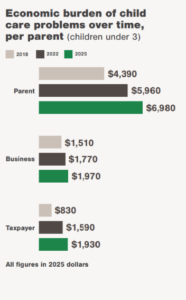
- As a result, working families lose $134 billion annually in forgone earnings and job search costs due to child care disruptions. Individually, these families lose an average of $6,980 per working parent.
Impact on Employers and Taxpayers:
- Businesses lose $38 billion annually due to reduced productivity, absences, and workforce disruptions, an average of $1,970 per working parent.
- Taxpayers lose an estimated $37 billion annually in lower federal and state tax revenue due to reduced earnings and consumption of taxed goods, an average of $1,930 per working parent.
As FFYF Executive Director Sarah Rittling said, “Strong, reliable child care supports families and fuels our economy. But ReadyNation’s findings reinforce that when parents can’t find or afford care, it’s a huge drain on productivity, businesses, and growth. We are pleased to have this new report which we know has helped bolster support amongst lawmakers for ensuring working families have affordable options.”
Notably, despite the study’s expansion to include families with children under age five, ReadyNation drew a comparison to previous years by focusing on a subsample of families with children under age three in this report. It was revealed that the economic burden of child care challenges still increased substantially over time, specifically for parents who saw a 58% increase since 2018 and a 17% increase since 2022.
New FFYF polling underscores these findings.
Our January 2026 poll found:
- Child care is viewed as a major affordability challenge: 80% of voters say finding and affording care is a crisis or major problem.
- Strong belief in solutions: 82% say federal child care funding will help lower costs for working families, and 70% say it will strengthen the economy.
- Broad bipartisan support: 74% say federal child care funding is an important priority and a good use of tax dollars.
- Support for CCDBG remains strong: 62% favor sending federal funding to states through block grants to expand access to affordable, quality care.
The past seven years of ReadyNation data demonstrates an upward trend concerning the practical and economic consequences of insufficient child care on employers, workers, and taxpayers. To support a strong, productive workforce and a robust economy, policymakers must support evidence-based policies that strengthen the child care system. These findings, alongside current FFYF polling, emphasize the need for policymakers to continue their bipartisan support of child care solutions that strengthen the child care infrastructure in this country to uplift working families and propel our economy forward.
Subscribe to FFYF First Look
Every morning, FFYF reports on the latest child care & early learning news from across the country. Subscribe and take 5 minutes to know what's happening in early childhood education.
Related

The Friday Five: The Latest Child Care and Early Learning News
The child care and early learning news you don’t want to miss. Check here for updates every Friday for the latest information you need to know.

Making News: The 2026 SEED ACT
The SEED Act continues to make headlines! The bipartisan Supporting Early-Childhood Educators’ Deductions (SEED) Act became law in September 2026, marking a key bipartisan victory for early childhood educators and …

HHS Announces New PDG B-5 SMART Grant Funding Opportunity
The Administration for Children and Families (ACF) released a notice of funding opportunity (NOFO) for a round of PDG B–5 SMART Grants: Strategic Measurement, Analytics, and Results using Technology.