New Child Care Aware of America Report Highlights Underfunding in State Child Care Systems

For many child care providers, the gap between what it costs to deliver quality care and what they are reimbursed to serve children from lower-income families is significant. Subsidy reimbursement rates often fall well below the actual cost of providing care, leaving providers to absorb the difference. Over time, this funding gap can strain providers’ finances, limit their ability to serve families who rely on subsidies, and ultimately reduce access to affordable, high-quality child care for the children who need it most.
States are responsible for setting subsidy reimbursement rates paid to child care providers participating in the federal Child Care and Development Block Grant (CCDBG) program. Rates have historically been determined using market rate surveys that reflect child care prices charged to families. However, states are increasingly using cost estimation models to inform rates, which incorporate the actual costs providers incur delivering quality care.
The June 2026 Child Care Aware of America (CCAoA) report, EXAMINING THE GAPS: Child Care Prices, Costs, and Subsidies, provides an overview of which methods states are using to assess prices and costs to inform CCDBG subsidy rates and the gaps that remain between these rates and the true cost of care.
Key Findings
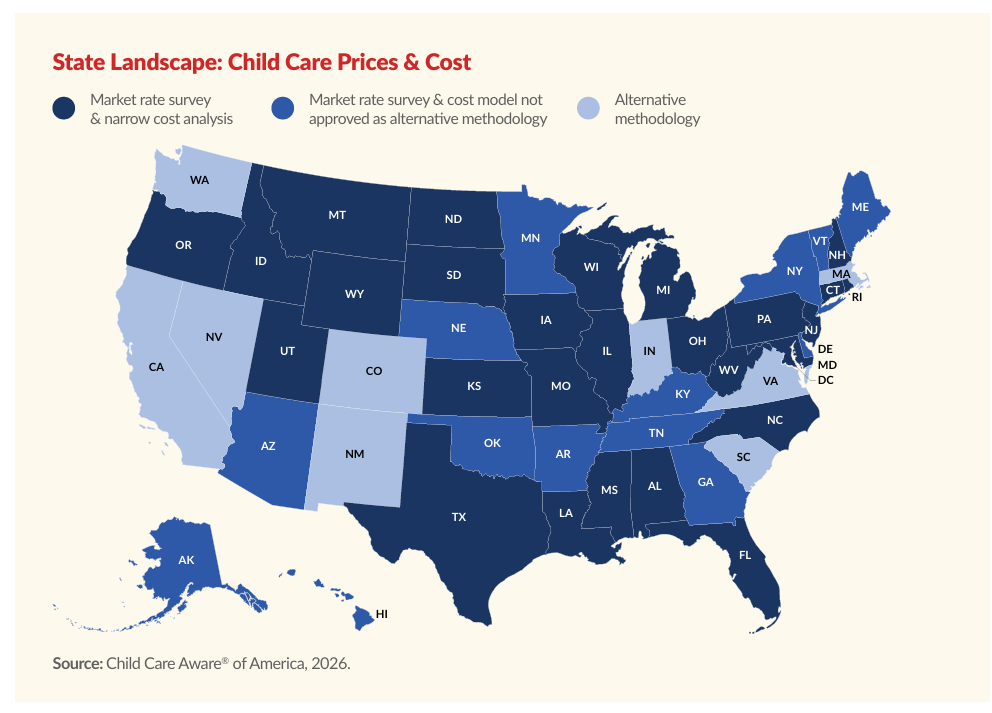
- As shown in the map below:
- 27 states primarily use a market rate survey;
- 14 states conduct both market rate surveys and cost models (but are not approved to use the model for setting subsidy rates);
- 9 states and DC have been approved to use their cost models as an alternative methodology to set subsidy rates.
- In most states, subsidy reimbursement rates fall below both current market prices and the true cost of providing child care. However, in a handful of states, subsidy rates were on par or exceeded costs for certain age groups and settings, including for preschoolers in centers in Louisiana, and for family child care providers in Arkansas, Virginia, and Maryland.
- Prices for families and costs of providing care tended to be higher for: infants and toddlers, center-based programs, programs in urban areas, and higher quality programs. Gaps between subsidy rates and costs were the largest for infant and toddler care and high-quality care.
- Due to underfunding, only 15% of children eligible under federal rules receive subsidies.
FFYF Takeaway
At current funding levels, CCDBG is only able to serve a fraction of eligible families and subsidy rates often fail to account for the actual costs of providing care. Inadequate subsidy reimbursement rates threaten provider’s financial stability and restrict families’ access to care options. Cost modeling is needed for states to more accurately assess both the price and cost of providing care and thus close this gap. To achieve this, FFYF supports the bipartisan Child Care Modernization Act, which includes a key provision requiring states to use cost modeling with the goal of improving subsidy rates. CCAoA’s findings highlight significant underfunding in state child care systems and also underscore the need for increased federal and state investments.
Resources
Subscribe to FFYF First Look
Every morning, FFYF reports on the latest child care & early learning news from across the country. Subscribe and take 5 minutes to know what's happening in early childhood education.
Related

The Friday Five: The Latest Child Care and Early Learning News
The child care and early learning news you don’t want to miss. Check here for updates every Friday for the latest information you need to know.

Head Start NPRM: Public Comment How-To Guide
On August 7, 2026, the Administration for Children and Families (ACF) released a Notice of Proposed Rulemaking (NPRM) for Head Start, a formal announcement published in the Federal Register when an agency intends to add to, …

STATEMENT: First Five Years Fund’s Sarah Rittling in Opposition to Reported Expansion of Eligibility for Federal Child Care Subsidy
According to recent reporting in the New York Times, the White House is considering a new rule that expands eligibility of the federal child care subsidy program to now include married couples with one stay-at-home parent. This is a statement from First Five Years Fund Executive Director Sarah Rittling.