New Brookings Report: Child Care Costs Continue to Strain Family Budgets

A new report released by Brookings states that millions of families across the country are struggling to make ends meet due to the rising cost of child care. With child care costs increasing at a higher rate than inflation, families with young children have cited child care as one of their top affordability concerns. For many families, the decision to enroll in child care is linked to their ability to afford other basic necessities, like groceries, rent, and health care.
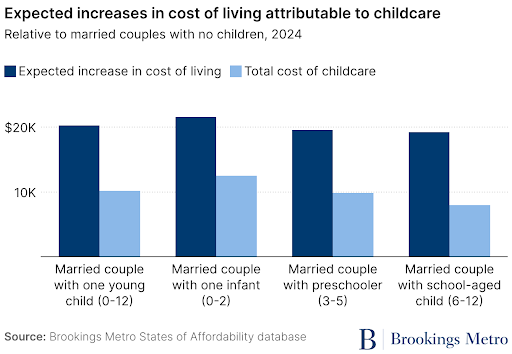
As depicted in the following graph, families with one child pay significantly more for necessities than married couples without children, with child care alone being a significant driver.
Federal programs like the Child Care and Development Block Grant (CCDBG) are essential to helping families afford child care. However, current funding levels reach only a fraction of eligible families. The potential for relief through this program is slowed by insufficient funding and restrictive eligibility standards based on family income.
Key Findings
- Nearly 16 million families (59%) with children aged 12 and under struggled to make ends meet in 2024. Of those, 4 million families indicated that it was the cost of child care that pushed them into financial insecurity. Child care is an economic issue, not just a family issue. Roughly 500,000 women left the labor force last year, noting child care and caregiving responsibilities as the primary cause.
- Capping costs at equitable and affordable thresholds would allow an additional 1.3 million parents of young children to participate in the labor force.
- CCDF is intended to support lower-income families, but now, child care costs are out of reach for middle-class families as well. If federal subsidies were based on a universal sliding scale, over 3 million more families would be able to make ends meet.
Brookings’ report reveals the ongoing reality for American families with young children: the cost of child care is pushing families into financial instability. It shapes decisions about whether parents can work, how many hours they can work and even whether it makes financial sense to have more children.
FFYF’s Takeaways
In line with these statistics, FFYF’s new poll finds that families see child care as a key driver of the affordability crisis and that Americans want Congress to act.
- Voters are feeling strained by the cost of living, and child care costs are a big part of the problem. More than 8 in 10 voters say the cost of child care is a part of the affordability crisis (82%). 3 in 4 see the cost of child care for families with young children as a crisis or major problem (76%).
- Child care challenges affect both parents’ and non-parents’ ability to participate in the labor force. Nearly 40% of all voters say their ability to work is affected by coworkers’ child care challenges. 1 out of every 5 parents with young children say child care challenges frequently impact their ability to work.
- Democrats and Republicans should work together to get something done. One in three voters think that gridlock in Congress, rather than just one political party, is holding back progress on making child care more affordable. Nearly 50% of Democratic voters think Democrats in Congress should work with Republicans and the President to pass child care legislation.
- Voters support bipartisan legislation, like the Child Care Modernization Act (CCMA), which would build the supply of care and strengthen the existing child care system. CCMA has strong bipartisan support with almost two-thirds of voters supporting the bill, and just one in five opposing (63% support / 21% oppose).
New polling underscores American voters’ concerns about child care affordability and rising costs driving parents out of the workforce. Members of Congress should act by supporting the Child Care Modernization Act and prioritizing investments in federal child care and early learning programs through the Appropriations process.
Bottom Line
Increasing federal investments in child care would help more families afford care and support greater labor force participation. As policymakers continue to address affordability, child care should remain a central part of that conversation.
Learn More
Subscribe to FFYF First Look
Every morning, FFYF reports on the latest child care & early learning news from across the country. Subscribe and take 5 minutes to know what's happening in early childhood education.
Related

The Friday Five: The Latest Child Care and Early Learning News
The child care and early learning news you don’t want to miss. Check here for updates every Friday for the latest information you need to know.

Making News: The 2026 SEED ACT
The SEED Act continues to make headlines! The bipartisan Supporting Early-Childhood Educators’ Deductions (SEED) Act became law in September 2026, marking a key bipartisan victory for early childhood educators and …

HHS Announces New PDG B-5 SMART Grant Funding Opportunity
The Administration for Children and Families (ACF) released a notice of funding opportunity (NOFO) for a round of PDG B–5 SMART Grants: Strategic Measurement, Analytics, and Results using Technology.