Cost Estimation Models: Increasing Child Care Stability Through More Accurate Provider Payment Rates

Cost Estimation Models allow states to better align provider payment rates with the actual cost of providing quality child care. This strengthens the workforce, enhances the quality of care children receive, and reinforces child care as a whole. Here’s a look at how they work.
The Benefit of Cost Estimation Models
Cost estimation models help states better meet the growing child care needs of working families and child care providers. More accurate payment rates give providers increased financial and programmatic stability. This means they are more likely to remain open, giving parents more options for quality care.
Using a cost estimation model helps states:
- Reflect key factors impacting the cost of delivery, such as training and professional development, staff salaries and benefits, facility costs, enrollment levels, program size, supplies, and more.
- Account for variations in costs across submarkets, including child age groupings, geographic regions, provider types, and the specific needs of children (e.g., children in protective services or with disabilities).
- Have the ability to set payment rates that align with the true cost of care. Higher payment rates allow existing providers to improve the quality of care and encourage new providers to participate, expanding options for families.
- Improve strategic planning by helping states understand the financial impacts of policy or program changes, such as increasing payment rates to support adequate compensation for the child care workforce.
Cost Estimation Models In Action
Eight states and Washington, D.C. (CA, CO, DC, IN, MA, NV, NM, SC, and VA) have implemented or are currently transitioning to a cost estimation model as a more accurate way to determine child care provider payment rates.
VIRGINIA: Shifting to a cost estimation model increased the center-based payment rates for infants by $60 a week, while the weekly payment rate for family child care providers increased by $130 per infant and $145 per toddler/preschooler. (After the switch, Virginia also saw an overall increase in the number of licensed family child care providers, reversing a multi-year trend.)
SOUTH CAROLINA: Shifting to a cost estimation model increased the weekly payment rate for family child care providers from $150 to $215, an increase of $65 per child per week.
How Cost Estimation Models Work
The Child Care and Development Fund (CCDF) is a block grant that allows states, tribes, and territories to subsidize the cost of child care for lower-income families. It’s comprised of two financing mechanisms:
- The Child Care and Development Block Grant (CCDBG), which are discretionary funds set during the appropriations process;
- The Child Care Entitlement to States (CCES), which are mandatory and matching funds determined by law.
CCDF allows states to offer child care subsidies to low-income families with children under age 13 (with a majority serving children ages five and under). Managed by the Administration for Children and Families (ACF) within the U.S. Department of Health and Human Services (HHS), these grants are awarded to State Lead Agencies, which establish the payment rates child care providers receive for serving eligible families.
Market Rate Surveys vs. Cost Estimation Models
Historically, these payment rates have been determined solely by collecting data on the tuition and fees that child care programs in the same geographic area charge families, known as a “market rate survey.” However, since market rate surveys place an outsized emphasis on what families in the market are charged for care at a specific point in time, using this method often forces providers to set prices lower than the actual cost of service delivery, and as a result, compensation and quality suffer.
In recent years, there has been a shift toward using “cost estimation modeling” to determine rates. Cost estimation models account for both the market price of child care and the costs providers shoulder to offer quality services, helping to more accurately reflect the true cost of providing care.
Beginning in 2014, the CCDBG Act required states to consider the actual cost of providing child care when setting payment rates, allowing them to use pre-approved alternative methods such as cost estimation models.
Over time, the federal government can support more states in adopting these models by providing additional resources, technical assistance, funding, and data, helping to strengthen and stabilize child care systems nationwide.
The Cost Of Care Gap
Child care providers operate on thin margins due to high staffing and operational costs. They must employ qualified staff to maintain safe adult-child ratios and face rising expenses for salaries, insurance, rent, and supplies.
Having a gap between the actual cost of care and the rate providers are reimbursed financially constrains programs, often forcing difficult decisions such as cutting staff wages or delaying essential facilities improvements, ultimately affecting service quality.
Additionally, when payment rates are insufficient, providers may be forced to turn to private-pay families who can more accurately cover the cost of service delivery, reducing the supply of providers available to lower-income families through the Child Care and Development Fund (CCDF).
Making Improvements: The Child Care Modernization Act
In the 119th Congress, Senators Deb Fischer (R-NE) and Kirsten Gillibrand (D-NY) introduced the bipartisan Child Care Modernization Act of 2025, which would strengthen the federal Child Care and Development Block Grant (CCDBG) program and enable states to better meet the growing needs of families and providers.
Cost Estimation Models
The legislation would require states to develop and implement cost estimation models that would better align CCDF provider payment rates with the true cost of quality care (giving states five years to make updates, to ensure ample time to adapt).
The rates would take into consideration:
- Variations in cost by submarket and provider type;
- Needs of children served, including geographic area, ages, and specific needs;
- Whether services are being delivered during non-traditional hours;
- The quality of the care provided.
Additionally, the bill would call for payment rates to be revised every two years and include cost of living increases to maintain the level of services year over year.
Other Provisions
Along with cost estimation models, the Child Care Modernization Act contains other provisions to strengthen care and increase options, including:
- Providing technical assistance to in-home and rural providers;
- Establishing new child care supply and facilities grants;
- Directing the Department of Agriculture to remove some regulatory burdens that can restrict home-based providers in rural areas;
- Giving states the flexibility to expand eligibility to include more working families.
Learn More
- First Five Things To Know About: The Child Care Modernization Act
- Side-by-Side Analysis: Comparison of the 2025 Child Care Modernization Act to Current Law
Print Friendly Version
Subscribe to FFYF First Look
Every morning, FFYF reports on the latest child care & early learning news from across the country. Subscribe and take 5 minutes to know what's happening in early childhood education.
Related

The Friday Five: The Latest Child Care and Early Learning News
The child care and early learning news you don’t want to miss. Check here for updates every Friday for the latest information you need to know. March 20 Capitol Hill …

Enrollment and Attendance Payment Models: Child Care & Development Block Grant (CCDBG)
Overview: States have the flexibility to pay child care providers participating in subsidy programs based on either enrollment or attendance. With enrollment-based payment, providers receive a set amount for holding …
FFYF Hosts Bipartisan Child Care and Early Learning Briefing on Capitol Hill
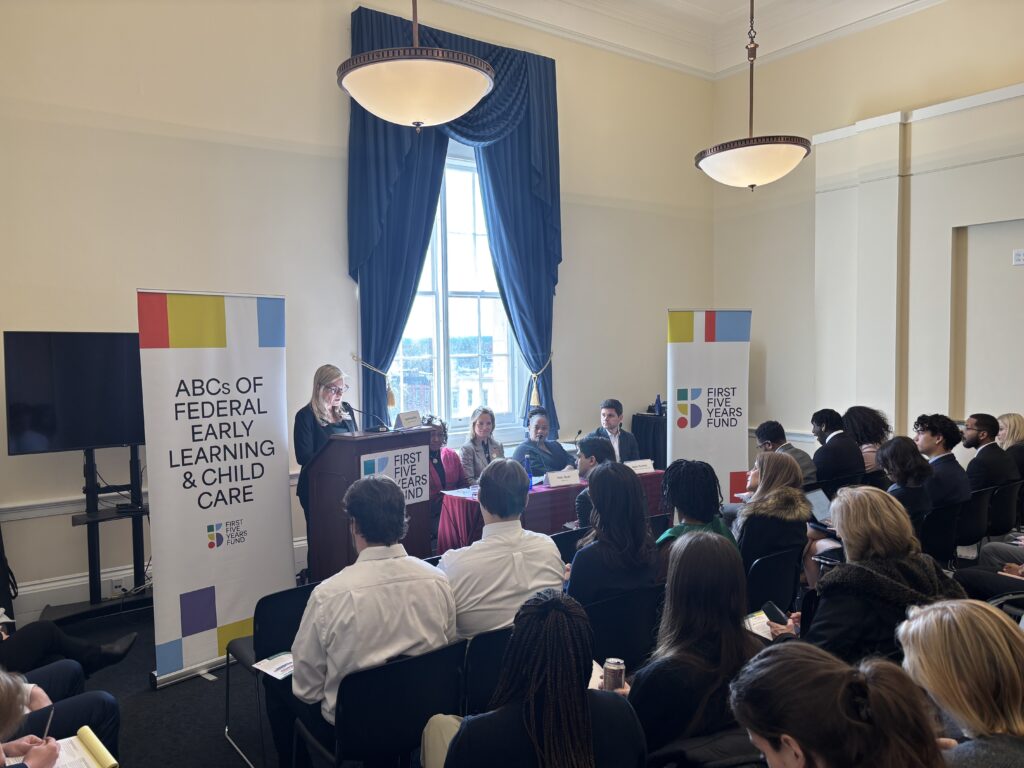
WASHINGTON, D.C. – The First Five Years Fund (FFYF), in conjunction with the Bipartisan Pre-K and Child Care Caucus, hosted congressional staff for its annual “ABCs of Federal Early Learning …