Early Progress Found with Cost-Sharing in Missouri

American families continue to struggle to afford child care. In fact, in a 2026 national poll conducted on behalf of First Five Years Fund, 80% of voters said working parents’ ability to find and afford child care is in a “state of crisis” or a “major problem.” Without sufficient federal funding to fill the gap, some states are implementing cost-sharing models to provide relief for families.
Cost Sharing Models
Cost-sharing models are a method of splitting child care costs among key stakeholders in order to make child care more affordable. Stakeholders often include families, employers, state and/or local funding sources, and philanthropic entities.
Cost-Sharing In Missouri
In Missouri, Child Care Aware of Missouri (CCAMO), in partnership with Kids Win Missouri, has implemented a unique cost-sharing initiative called Missouri Child Care Works (CCW). Executive Director of Kids Win Missouri, Brian Schmidt, recently detailed the program’s progress and key operational takeaways on his Substack.
Missouri’s model is built around prioritizing local leadership, reducing administrative burden through supportive statewide infrastructure, and flexibility in funding structures. CCW recognized that local organizations are best positioned to know which employers are ready to engage, what local and philanthropic funding can be leveraged to support cost-sharing, and the needs of their communities. This meant creating a centralized platform to support these leaders in administering diverse funds to share the cost of care in ways that best suit their community. Additionally, Schmidt emphasized that the typical fixed three-way split between employer, employee, and a state funding source (known as tri-share) can be limiting, especially if not all employees meet the income eligibility requirements of that state funding source. As a result of this, CCW builds in alternative cost-sharing options, including duo-share, which allows the cost of care to be exclusively shared between employer and employee. To see other examples of Missouri’s flexible benefit structures click here.
Progress in Missouri
This focus on flexibility and local leadership has led to notable progress just five months after implementation. Currently:
- 34 employers are actively participating in Child Care Works, the majority of which are private businesses;
- In total, employers have committed more than 160 seats reserved for employees to fill as they enroll;
- 50 of these seats are already in active use.
Cost-Sharing and 45F
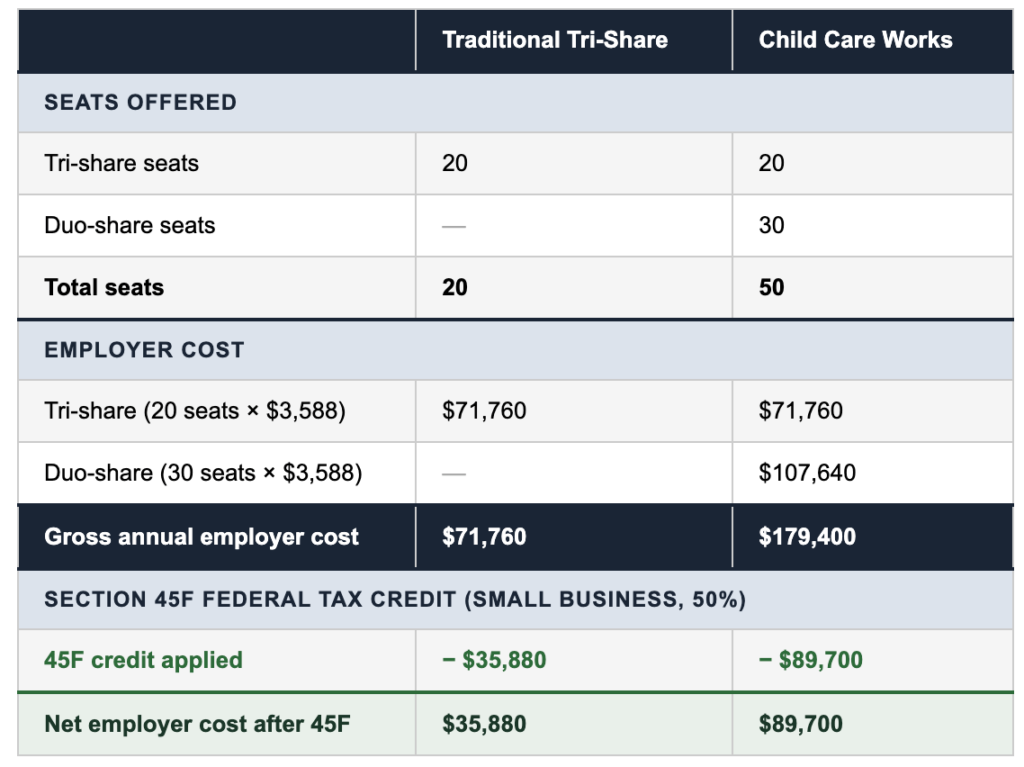
Cost-sharing models can be enhanced by taking advantage of the recent expansion of the child care tax credits (FFYF explains the expansion of these credits here). The 45F tax credit is especially helpful, as it now allows larger businesses to deduct 40% of their qualified child care expenses (with a maximum credit of $500,000) and smaller businesses to deduct 50% of qualified child care expenses (with a maximum credit of $600,000). This means that businesses participating in cost-sharing would be able to receive up to 40% or 50% of those qualified expenses back as a credit that could be used to reduce their overall tax burden. CCW supports employers through the process of claiming the 45F credit in their continued effort to make participation in the cost-sharing model more affordable and attractive for businesses.
Here is an example of how 45F could support cost-sharing in Missouri:
Bottom Line
Missouri has made progress in building its cost-sharing model by creating statewide infrastructure that empowers local leadership and increases funding flexibility. This approach allows businesses to participate in ways that are more predictable and better serve their workforce. Combined with the advantages of tax credits like 45F, this flexibility better supports families by making the Missouri model a more viable option for both businesses and local communities. The Missouri Child Care Works initiative reflects many of the strategies FFYF has championed to strengthen the child care system, including expanding access to affordable care, supporting working families, and fostering innovative public-private partnerships that engage employers in addressing child care challenges.
Subscribe to FFYF First Look
Every morning, FFYF reports on the latest child care & early learning news from across the country. Subscribe and take 5 minutes to know what's happening in early childhood education.
Related

The Expanded 45F Tax Credit: What Providers and Employers Need to Know
This resource explains how the expanded 45F tax credit works and how employers and providers can get started.

New Joint Economic Committee (JEC) Minority Report Highlights Impact of Child Care Tax Credits
Existing child care tax incentives are a tool that can reduce child care costs for families while delivering a strong return on investment for employers.

Toolkit: Child Care Tax Credits
The tools you need to highlight how child care tax credits help make care more accessible and affordable for families nationwide.