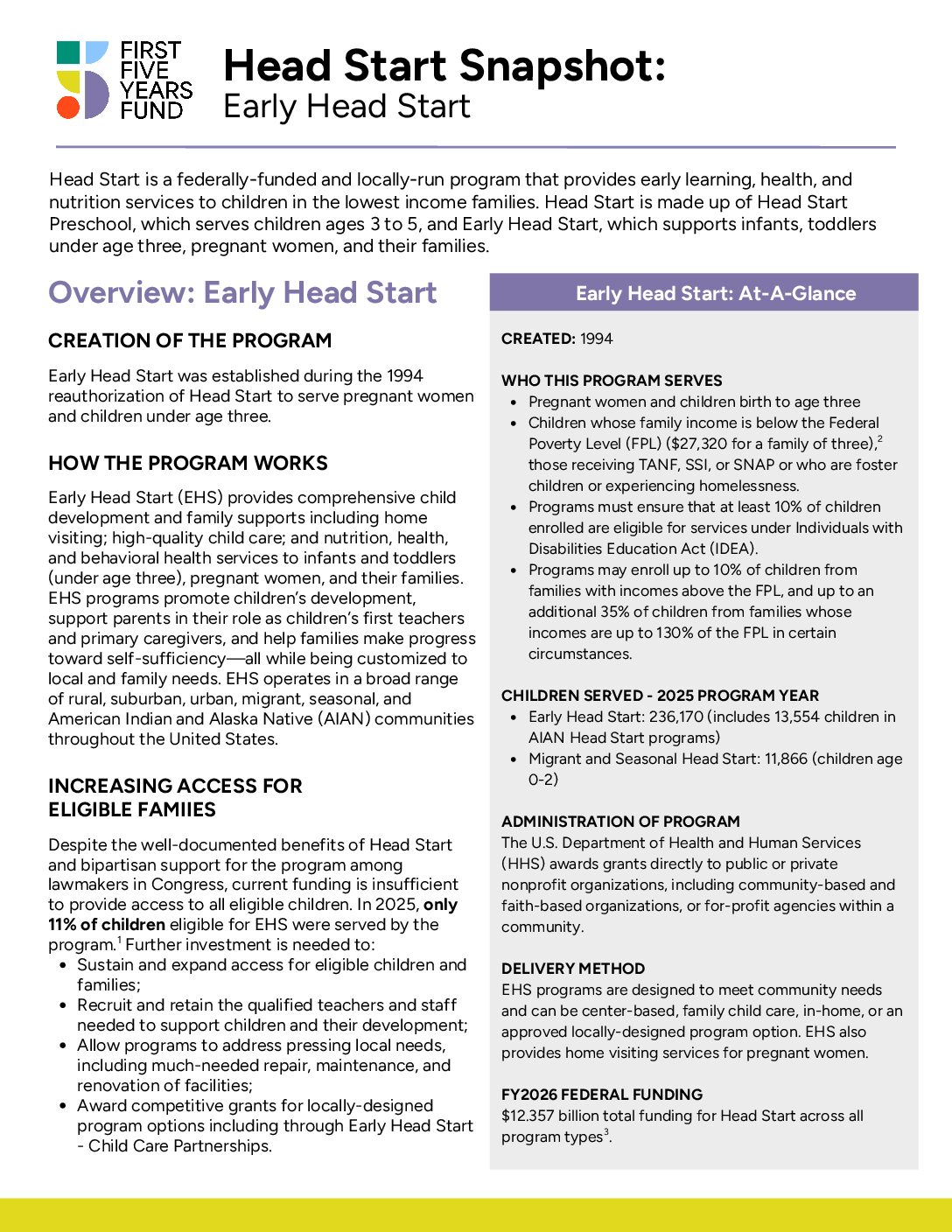
Head Start Snapshot: Early Head Start
Head Start is a federally-funded and locally-run program that provides early learning, health, and nutrition services to children in the lowest income families. Head Start is made up of Head Start Preschool, which serves children ages 3 to 5, and Early Head Start, which supports infants, toddlers under age three, pregnant women, and their families.
Overview: Early Head Start
CREATION OF PROGRAM
Early Head Start was established during the 1994 reauthorization of Head Start to serve pregnant women and children under age three during a critical developmental period when interventions are most effective.
HOW THE PROGRAM WORKS
Early Head Start (EHS) provides comprehensive child development and family supports including home visiting; high-quality child care; and nutrition, health, and behavioral health services to infants and toddlers (under age three), pregnant women, and their families. EHS programs promote children’s development, support parents in their role as children’s first teachers and primary caregivers, and help families make progress toward self-sufficiency—all while being customized to local and family needs. EHS operates in a broad range of rural, suburban, urban, migrant, seasonal, and American Indian and Alaska Native (AIAN) communities throughout the United States.
INCREASING ACCESS FOR ELIGIBLE FAMILIES
Despite the well-documented benefits of Head Start and bipartisan support for the program among lawmakers in Congress, current funding is insufficient to provide access to all eligible children. In 2025, only 11% of children eligible for EHS were served by the program.1 Further investment is needed to sustain and expand access for eligible children and families; recruit and retain the qualified teachers and staff needed to support children and their development; allow programs to address pressing local needs, including much-needed repair, maintenance, and renovation of facilities; and award competitive grants for locally-designed program options including through Early Head Start – Child Care Partnerships.
Early Head Start: At-A-Glance
CREATED: 1994
WHO THIS PROGRAM SERVES:
- Pregnant women and children birth to age three
- Children whose family income is below the federal poverty guidelines ($27,320 for a family of three),2 those receiving TANF, SSI, or SNAP or who are foster children or experiencing homelessness.
- Programs must ensure that at least 10% of children enrolled are eligible for services under Individuals with Disabilities Education Act (IDEA).
- Programs may enroll up to 10% of children from families with incomes above the Federal Poverty Level, and up to an additional 35% of children from families whose incomes are up to 130% of the (FPL) in certain circumstances.
NUMBER OF CHILDREN SERVED IN THE 2025 PROGRAM YEAR:
Early Head Start: 236,170 (includes 13,554 children in AIAN Head Start programs)
Migrant and Seasonal Head Start: 11,866 (children age 0-2)
ADMINISTRATION OF PROGRAM: The U.S. Department of Health and Human Services (HHS) awards grants directly to public or private nonprofit organizations, including community-based and faith-based organizations, or for-profit agencies within a community.
DELIVERY METHOD: EHS programs are designed to meet community needs and can be center-based, family child care, in-home, or an approved locally-designed program option. EHS also provides home visiting services for pregnant women.
FY2026 FEDERAL FUNDING: $12.357 billion total funding for Head Start across all program types.3
The Impact on Children and Families
Research shows that participation in EHS benefits both children and families in many ways. We also know those who continue on to Head Start Preschool are more ready for kindergarten, with positive impacts sustained through at least fifth grade. Parents’ participation in EHS also improves their parenting skills and strengthens father engagement.
- Children enrolled in EHS:
- Are more likely to be immunized.
- Are more likely to receive services if they have a diagnosed disability.
- Show significantly better emotional, behavioral, language, and cognitive development, compared to non-participants.
- Children in families involved in the child welfare system are 93% less likely to be placed in foster care.4
- EHS families are more likely to receive services related to employment, education/job training, and early intervention compared to other parents of young children from low-income families.5
Early Head Start/ChildCare Partnerships (EHS-CCP)
Early Head Start – Child Care Partnerships (EHS-CCP) is a competitive grant program that pairs EHS grantees with local child care providers to expand access to high-quality child care and comprehensive supports for infants and toddlers. EHS grantees help providers receiving federal child care subsidies to meet Head Start quality standards and leverage funds to provide nutrition, health, and behavioral health services for all children. This innovative approach has been shown to improve the quality of care across communities, while also expanding access to essential services for children and parents.
CREATED: 2013
WHO THIS PROGRAM SERVES: Supports infants and toddlers (birth to age three) from low-income families by partnering Early Head Start (EHS) grantees with child care providers in a variety of child care settings, including center-based and home-based child care.
DELIVERY METHOD: HHS awards grants to EHS programs that partner with child care providers who participate in the Child Care and Development Fund (CCDF). Grantees must reapply for these awards every five years.
FY2026 FEDERAL FUNDING: Not specified. EHS-CCP falls under Head Start, which is funded at $12.357 billion for FY2026.
More Head Start Snapshots:
Learn more:
- Head Start Act – 42 U.S.C. §§ 9831(2); 9833(1); 9836(c)(1), (d)(2)(B); 9836a(a)(1)(A); 9837(f)(9); 9837b(a)(2)(B)(iv); and 9840a(b)(1)
- Head Start and Early Head Start Program Overview
- Head Start Program Core Elements
- Head Start Map & State Fact Sheets
- 2026 Head Start and Early Head Start
Download
Sources
- First Five Years Fund, “Child Care & Early Learning in the United States 2026 State Fact Sheet” ↩︎
- Office of the Assistant Secretary for Planning and Evaluation, “Poverty Guidelines” ↩︎
- Note: Allocations to the different program types are made at the discretion of HHS ↩︎
- National Head Start Association, “Early Head Start Facts and Figures” (2023) ↩︎
- National Head Start Association, “Unpacking How Comprehensive Services in Early Head Start Lead to Impacts for Children & Families,” (2022) ↩︎
Subscribe to FFYF First Look
Every morning, FFYF reports on the latest child care & early learning news from across the country. Subscribe and take 5 minutes to know what's happening in early childhood education.
Related

Head Start and Early Head Start: The Program Overview
This one-pager provides data and information on how Head Start works and who it serves.
Comments: 2026 Head Start Notice of Proposed Rulemaking
The following comments were submitted electronically by First Five Years Fund to the Administration for Children and Families via www.regulations.gov on October 5, 2026. Re: Comments on Notice of Proposed Rulemaking: …
A Closer Look at HHS’s Head Start Comprehensive Services Data
Head Start is designed to support the whole child and the whole family, which is why comprehensive services are central to the model.