Analysis: The Head Start NPRM

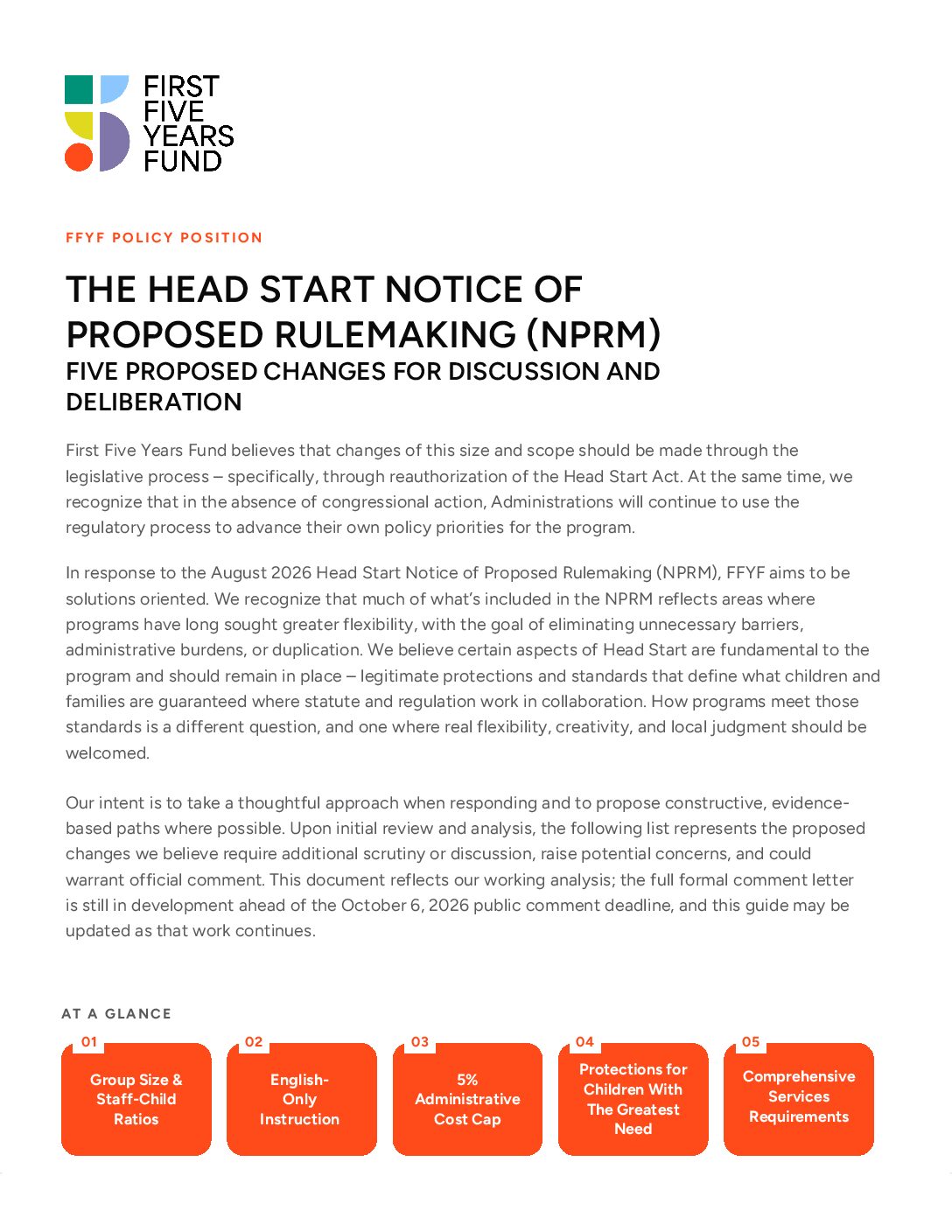
Five Proposed Changes for Discussion and Deliberation
First Five Years Fund believes that changes of this size and scope should be made through the legislative process – specifically, through reauthorization of the Head Start Act. At the same time, we recognize that in the absence of congressional action, Administrations will continue to use the regulatory process to advance their own policy priorities for the program.
In response to the August 2026 Head Start Notice of Proposed Rulemaking (NPRM), FFYF aims to be solutions oriented. We recognize that much of what’s included in the NPRM reflects areas where programs have long sought greater flexibility, with the goal of eliminating unnecessary barriers, administrative burdens, or duplication. We believe certain aspects of Head Start are fundamental to the program and should remain in place – legitimate protections and standards that define what children and families are guaranteed where statute and regulation work in collaboration. How programs meet those standards is a different question, and one where real flexibility, creativity, and local judgment should be welcomed.
Our intent is to take a thoughtful approach when responding and to propose constructive, evidence-based paths where possible. Upon initial review and analysis, the following list represents the proposed changes we believe require additional scrutiny or discussion, raise potential concerns, and could warrant official comment. This document reflects our working analysis; the full formal comment letter is still in development ahead of the October 6, 2026 public comment deadline, and this guide may be updated as that work continues.
OVERARCHING QUESTIONS
REGULATORY IMPACT ANALYSIS (RIA) SECTION OF THE NPRM
The RIA’s Numbers Contradict the Rule’s Flexibility Frame
In recent years, some Head Start critics have sown doubt about the program’s value and effectiveness. This has led many programs and advocates to approach this NPRM with skepticism. Against this backdrop, a rule that promises programs flexibility and choice, but is supported by RIA that claims savings from large-scale changes, reads differently than it might otherwise.
Taken individually, each gap in the RIA’s methodology might be an oversight: cuts booked as transfers, research cited for a conclusion its own authors say they don’t support, and savings estimates that assume uniform compliance in a proposed rule framed around choice. Taken together, the pattern is harder to read as coincidental. At minimum, it raises a fair question – does this proposed rule’s practical effect match its stated purpose of reducing burden, or does it lay the groundwork for a different case that plans to be made about Head Start’s effectiveness down the line? An RIA that is inconsistent with the NPRM’s purpose forces many to question whether ‘flexibility’ means ACF would truly be giving programs choice.
IMPLEMENTATION
Rollout and Monitoring with 50+ Standards
The NPRM has generated many questions about how, if finalized, this rule would actually be implemented – how it would be rolled out, compliance would be monitored, and accountability would be measured across programs with different standards. The most frequent questions include:
- If the Classroom Assessment Scoring System (CLASS) is eliminated without a named replacement, how would ACF – or anyone – know whether a program is still delivering quality care?
- If CLASS is eliminated and ratios vary by state, what would be left – besides cost – to measure and compare program quality?
- What standard would apply to roughly one-quarter of Head Start sites operating in certain settings that are exempt from state licensing?
- Could cost per child become the default yardstick ACF uses for funding, renewal, and expansion decisions, simply because it is one of the only things to compare across programs?
- Could programs that hold ratios steady, and therefore cost more per child, be judged as less “efficient” than programs that cut staffing to the state minimum?
- Could programs be implicitly rewarded for lowering ratios and penalized for protecting them, even though nothing in the rule states that as a goal?
- Would programs be forced to choose between adequate staffing and improvements – a renovated space, new technology, expanded hours – because both draw from the same limited funding?
- At what point does flexibility become a quiet cut to attention in the classroom, and staff qualified to give it?
ISSUES RISING TO THE TOP FOR
DISCUSSION AND DELIBERATION
1. GROUP SIZE AND STAFF-CHILD RATIOS
THE NPRM WOULD
Eliminate the federal group-size and staff-child ratio standards. Programs would no longer be required to meet a federal standard, only to be consistent with applicable state licensing law.
- A federal floor and local flexibility are not opposites. Ratios are what make it possible for a teacher to see, hear, and respond to each child – that matters most for children from low-income families, children under three, dual language learners, and those with developmental delays – exactly the population Head Start’s ratios are built to protect.
- The Head Start Act does not just permit the Secretary to set standards – it requires it. The statute also bars any revision that reduces the quality or scope of services below what was in place on December 12, 2007. This proposed rule would permit programs to be consistent with applicable state licensing law rather than federal ratio and group size requirements set in regulation on December 12, 2007. Also, by deferring to the states, the Secretary fails to set a standard, as required by the statute.
- The research ACF cites for this change explicitly calls out that its findings “should not be interpreted as indicating that regulation of ratios can be relaxed in any way.”
- The RIA estimates cost savings of $668 million a year by calculating a roughly 25% reduction in the teaching workforce, and 16-32% more children per teacher on average. Yet the language of the NPRM describes the proposed ratio adjustment as an optional flexibility. This calls into question the accuracy of the RIA, since the savings estimate only works if programs move away from current ratios at scale.
2. ENGLISH-ONLY INSTRUCTION
THE NPRM WOULD
Require all classroom instruction to be conducted in English, with no accommodation for children who are still building English proficiency.
- Every child should have the English skills they need to succeed in kindergarten and beyond.
- The research is clear. Young children build both content knowledge and a second language most effectively through instruction that builds on their home language, not instruction that excludes it. Suppressing a child’s home language is more likely to slow English acquisition than to speed it up.
- More than a third of the children Head Start serves are dual language learners. A mandate that reaches this far into classroom methods is not a burden-reduction measure – it is a new requirement and should be considered as such.
- ACF’s current guidance recommends home-language-connected instruction for dual language learners. This rule would reverse that guidance without presenting evidence that this change benefits children.
- The NPRM overlooks the Head Start Act’s own definition of “limited English proficient” (LEP): a child whose difficulty with English “may be sufficient to deny” them “the ability to successfully achieve in a classroom in which the language of instruction is English.” The statute assumes some children cannot succeed in English-only instruction without support; it then requires programs to identify these children and inform parents about the instructional services used to help them acquire English. The NPRM creates a conflict with the statute as it would require English-only instruction for the same children the statute defines as unable to succeed in an English-only classroom.
- The rule is inconsistent on its own terms: it exempts Tribal Head Start programs specifically to protect heritage-language instruction, which concedes that home-language instruction has real developmental and cultural value – while denying that same latitude to every other dual language learner.
3. THE 5% ADMINISTRATIVE COST CAP
THE NPRM WOULD
Cut the current 15% cap on administrative and development costs down to 5% of total approved program costs.
- As much funding as possible should be directed toward classrooms, but moving Head Start to a 5% rate would hold it to a different standard than other federal grantees. The Office of Management and Budget operates under a government-wide rule allowing nonprofits to claim a 15% rate for administrative costs.
- A 5% cap would not cut paperwork – it would cut the finance staff, HR staff, and auditors who run payroll, background checks, financial oversight, and keep public dollars accountable.
- This is a federal-to-local program with no state entity carrying the burden of administrative oversight; ACF cannot keep the mandates and remove the capacity to meet them.
- Only about 3.7% of Head Start grants currently operate at or below 5% administrative costs. This cap is not a realistic target for compliant programs.
- The Head Start Act sets 15% as the ceiling, allowing the Secretary to go lower on a case-by-case basis, only if a specific program’s costs are “excessive.” The statute does not grant the authority to reset the number to 5%, or any other percentage, across the board. This is not a tool available to the Secretary within the Head Start Act.
4. PROTECTIONS FOR CHILDREN WITH THE GREATEST NEED
THE NPRM WOULD
Repeal the specific policies and procedures implementing Head Start’s homelessness protections and replace them with a single general eligibility sentence.
A) ENROLLMENT AND ELIGIBILITY: Protections for Children Experiencing Homelessness
- Streamlining eligibility and enrollment paperwork would be a positive change, but that streamlining should not come at the cost of the procedures that assist homeless children in accessing Head Start in the first place.
- These are not abstract categories. They are the identification and prioritization steps, the grace period for missing paperwork, and the coordination with school-district homeless liaisons that get a family in the door before documents catch up. For a population already facing instability, time matters – every day a child experiencing homelessness isn’t enrolled is a day without the stability, routine, and support Head Start is designed to provide, at the exact moment they need it most.
- Head Start served more than 60,000 children experiencing homelessness last year – the highest number on record, and a growing share of enrollment even as total enrollment has declined.
- The NPRM goes further than removing procedures – it also proposes that self-attestation would no longer be sufficient to document a child’s homelessness. Families experiencing homelessness often lack formal documentation, and self-attestation has been the practical way programs verify eligibility without forcing a family to produce paperwork they may not have.
- This would establish a new mandate, doing so for this population is a new barrier. The RIA acknowledges the risk: it states that “some families, such as those experiencing homelessness, may have a more challenging time providing such documentation.” There is no mitigating mechanism beyond asking programs to “support such families more closely” – without specifying how, or with what resources.
- Congress’s word choice was deliberate, and it matters here: the statute requires both “policies and procedures,” not one or the other. A single eligibility sentence would provide neither.
B) DISABILITY SERVICES AND DISCIPLINE: Children with Disabilities and Suspension/Expulsion
THE NPRM WOULD
Replace Head Start’s specific disability services and discipline protections with a general instruction to follow existing state and federal law.
- Duplicate provisions that simply repeat general civil rights law can be simplified, but in cases where Head Start’s current standards go further than that baseline, it’s worth asking why – and in this case, the answer is child outcomes.
- In many communities, Head Start is the only option for children with disabilities and developmental delays. Head Start currently steps in to support children before a formal disability evaluation is complete, rather than waiting for a diagnosis to act. That bridge meets a real need for children and families. Eliminating those bridge services would leave a real gap in care for a particularly vulnerable group of children at a time of great need and uncertainty.
- Given the vulnerable populations the program is designed to serve, Head Start’s current rules have been carefully crafted to strictly limit and prohibit expelling or unenrolling a child for behavior. There are procedures in place to ensure safety and transitions in last resort situations. Federal civil rights data show preschoolers with disabilities are dramatically overrepresented in exclusionary discipline: they make up 24% of preschool enrollment nationally but account for 62% of preschool expulsions. Head Start’s current protections – a bridge to services before diagnosis, plus firm limits on suspension and a ban on expulsion for behavior – are built directly against that pattern – these are program strengths worth protecting under regulation.
- Monthly mental health consultation is one of the tools shown to reduce expulsion rates. Removing the requirement would only remove the guarantee that programs provide it; the need for that support will remain.
- This is the same pattern raised in the ‘Overarching Question’ section above: the NPRM’s own preamble states that if these requirements are removed from regulation, “the Secretary would issue policies and procedures to ensure these requirements are met” – a promise to act later, not a standard in effect now. Families and programs would be left complying with a requirement that exists in statute but not in any published procedure telling them how.
5. COMPREHENSIVE SERVICES REQUIREMENTS
THE NPRM WOULD
Eliminate the specific comprehensive services requirements – covering health, mental health, and family support – that have defined Head Start since its creation, replacing them with general, minimal standards.
- Comprehensive services aren’t a program add-on – they’re part of how the Head Start Act defines the program itself, requiring health, educational, nutritional, and social services alongside early learning.
- For many low-income families, Head Start is the only regular point of contact with developmental screening, dental and vision care, and mental health referral – and the strongest evidence for Head Start’s long-run impact, from high school graduation to health outcomes, credits this comprehensive model, not classroom instruction alone. Providing comprehensive services is a fundamental piece of Head Start; flexibility could come in ‘how’ programs meet the requirements, not whether the requirements exist. Regulations could be revised with that sentiment in mind – to ensure fundamental components but defer to programs as to how they are implemented to meet the standard.
- Health, nutrition, and social services are among the specific categories Congress sought to protect: the Act bars ACF from reducing their quality, scope, or type below what was in place on December 12, 2007.
LEARN MORE
FFYF State of Play: A page with updates, context, timelines and resources around the August 2026 Head Start NPRM.
FFYF Statement: A statement from FFYF Executive Director Sarah Rittling on the announcement of proposed changes to regulations governing Head Start.
FFYF FAQs: Answers to questions asked by providers, parents and advocates about what the NPRM would mean, including what would change and what would stay the same.
FFYF Searchable Guide: A line-by-line deep dive into the NPRM, with links to associated statute and regulations.
Public Comment How-To Guide: tips on how to draft comments, including links to resources summarizing and analyzing the NPRM, and step-by-step instructions on how to submit them.
Feedback Guide: Areas of the Head Start NPRM warranting thoughtful public comment and how to engage.
Comments: 2026 Head Start Notice of Proposed Rulemaking: Submitted electronically by FFYF to the Administration for Children and Families on October 5, 2026.
Subscribe to FFYF First Look
Every morning, FFYF reports on the latest child care & early learning news from across the country. Subscribe and take 5 minutes to know what's happening in early childhood education.
Related

Head Start and Early Head Start: The Program Overview
This one-pager provides data and information on how Head Start works and who it serves.

Comments: 2026 Head Start Notice of Proposed Rulemaking
The following comments were submitted electronically by First Five Years Fund to the Administration for Children and Families via www.regulations.gov on October 5, 2026. Re: Comments on Notice of Proposed Rulemaking: …

A Closer Look at HHS’s Head Start Comprehensive Services Data
Head Start is designed to support the whole child and the whole family, which is why comprehensive services are central to the model.